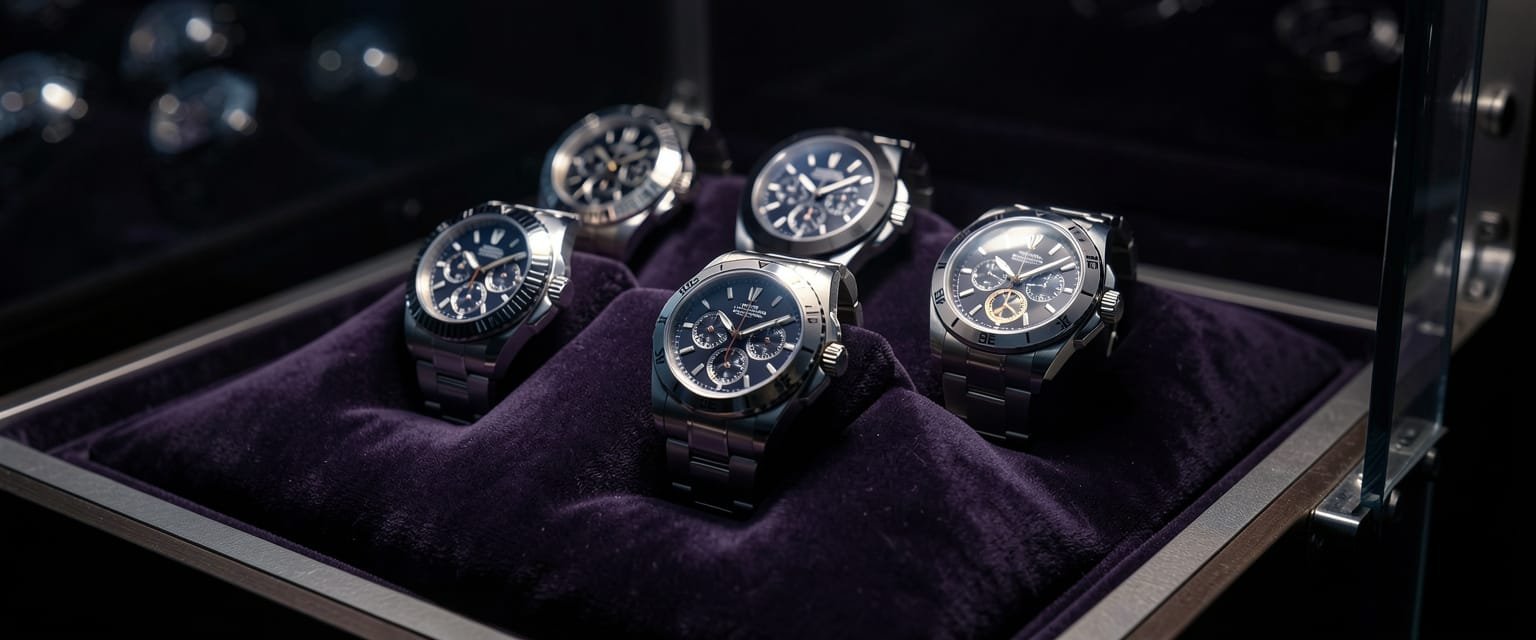

Akrivia Watches represent contemporary independent Geneva haute horlogerie at its most artisanal, combining Rexhep Rexhepi’s distinctive movement architecture, exceptional hand-finishing, traditional case-making, and extraordinarily limited production.
Founded in Geneva in 2012 by watchmaker Rexhep Rexhepi, Akrivia has become one of the most closely followed independent names in contemporary haute horlogerie. The atelier was created around Rexhepi’s ambition to produce exceptional mechanical watches according to traditional Swiss and Genevan watchmaking methods while developing a distinctly modern mechanical identity. Akrivia’s early watches were technically ambitious from the beginning. The inaugural AK-01 Tourbillon Chronographe Monopoussoir combined a tourbillon with a monopusher chronograph, establishing a pattern of complex mechanisms, exposed architecture, and intensive manual finishing. Later creations expanded into chiming watches, jumping-hour indications, openworked time-only movements, and sophisticated chronometers. Today, the atelier operates from Geneva’s Old Town and effectively presents two complementary identities: the architecturally expressive Akrivia collection and the more classical, highly limited Rexhep Rexhepi collection, which includes the celebrated Chronomètre Contemporain watches.
Akrivia occupies an exceptional position within modern independent watchmaking. Rather than competing through large production numbers or an extensive commercial catalog, the atelier concentrates on extraordinarily small quantities of watches in which movement construction, finishing, case-making, and traditional craftsmanship receive unusually intensive attention.
The name Akrivia comes from a Greek word associated with precision and meticulous attention to detail, an appropriate description of Rexhep Rexhepi’s approach. The watches frequently combine traditional Genevan finishing techniques with movement layouts that are visibly modern, symmetrical, and mechanically expressive.
The original Akrivia collection began with complicated tourbillon watches. The AK-01 Tourbillon Chronographe Monopoussoir established the company’s ambitions by combining a tourbillon regulator and single-button chronograph. Its manually wound movement offers approximately 100 hours of power reserve, reduced to around 72 hours with the chronograph running.
Another important early creation is the Tourbillon Chiming Jump Hour, also known as the AK-03. The watch combines three unusual elements: a tourbillon, an instantaneous digital jumping-hour display, and a mechanism that strikes a gong every time the hour changes. A silent mode allows the striking function to be switched off. Akrivia describes the combination as unprecedented in commercial fine watchmaking.
The AK-06 marked an important change of direction. Instead of relying on a tourbillon or another major complication, Rexhepi created a time-focused watch built around the beauty of its mechanism. The dial-free architecture exposes the power-reserve mechanism, oversized center wheel, jeweled barrel, and symmetrical mechanical components.
Its manually wound AK-06 caliber was developed, decorated, and assembled in-house and provides approximately 100 hours of power reserve. The movement also incorporates stop-balance and zero-seconds-reset functions. Black polishing, hand-applied anglage, Côtes de Genève, engraving, graining, and manually blued steel components demonstrate the atelier’s emphasis on finishing even relatively functional parts.
A second and increasingly important part of the Maison is the Rexhep Rexhepi collection. These watches carry Rexhepi’s own name rather than simply the Akrivia signature and use a more restrained, neo-classical design language.
The original Rexhep Rexhepi Chronomètre Contemporain, often abbreviated RRCC I, was introduced in 2018. Its 38mm round case, grand feu enamel dial, subsidiary seconds, and traditional proportions contrast sharply with Akrivia’s more architectural early watches.
Inside is the manually wound RR-01 movement, designed with strong symmetry and approximately 100 hours of power reserve. Both visible and concealed components are hand-finished using techniques such as anglage, black polishing, perlage, Côtes de Genève, graining, polishing, and engraving.
The Chronomètre Contemporain dramatically increased Akrivia’s international profile after winning the Men’s Watch Prize at the 2018 Grand Prix d’Horlogerie de Genève.
Its successor, the Chronomètre Contemporain II, or RRCC II, was presented for Akrivia’s tenth anniversary in 2022. Although visually related to its predecessor, the movement is completely new.
The RRCC II uses separate barrels and going trains: one provides energy to the balance, while another operates the independently driven dead-beat seconds. The seconds mechanism includes hacking and zero-reset functions, allowing precise synchronization. The hand-wound movement provides approximately 82 hours of power reserve.
The RRCC II again won the GPHG Men’s Watch Prize in 2022, making Rexhep Rexhepi a two-time winner of that category with successive generations of the Chronomètre Contemporain. The platinum version entered for the GPHG was listed at CHF 125,000 and limited to 50 pieces.
Case-making has become another major component of Akrivia’s identity. Legendary Swiss casemaker Jean-Pierre Hagmann joined the atelier in 2019 to establish an in-house case workshop and transfer traditional case-making knowledge to a younger generation of craftsmen. His cases bear the discreet JHP hallmark.
Modern RRCC II cases, for example, consist of 15 individual components and are produced using traditional methods and manually operated machinery under Hagmann’s supervision. Crowns are also individually milled by hand.
The one-off Chronomètre Antimagnétique demonstrates another side of Rexhepi’s work. Created around the tradition of scientific antimagnetic chronometers, it uses a Faraday cage formed by ferritic stainless-steel components to protect an entirely new hand-wound caliber from magnetic fields. The movement contains 239 components and includes central seconds with hacking and zero-reset functionality.
Akrivia has also entered carefully selected collaborations. The LVRR-01 Chronographe à Sonnerie, developed with Louis Vuitton, combines a tourbillon chronograph with a mechanism that produces an audible chime for each elapsed chronograph minute. Its platinum Tambour-derived case is manufactured at Atelier Akrivia under Jean-Pierre Hagmann’s supervision. The project marked Akrivia’s first collaboration with another watchmaking company since its founding.
Production remains exceptionally restricted, and availability is frequently more important than conventional retail pricing. Many pieces are allocated directly to collectors or offered in numbered editions, while unique watches can achieve prices far above their original retail values.
As a reference point, the platinum RRCC II was officially listed at CHF 125,000 when entered for the 2022 GPHG, while highly complicated collaborative pieces such as the LVRR-01 have reached approximately €500,000 at retail.
Positioned at the highest end of independent haute horlogerie, Akrivia Watches appeal to collectors seeking extremely low production, uncompromising hand-finishing, distinctive movement architecture, traditional Geneva craftsmanship, and the work of one of the most influential independent watchmakers of his generation.
Price Range: $80,000 – $500,000+ Approximate range. Availability is extremely limited, and prices for unique, discontinued, and secondary-market pieces may be substantially higher.
Positioning: Luxury
Yes. Akrivia is considered one of the leading contemporary independent haute horlogerie ateliers. Its watches are distinguished by proprietary mechanical movements, extensive hand-finishing, traditional Genevan craftsmanship, and extremely limited production.
Akrivia was founded in 2012 by watchmaker Rexhep Rexhepi. The atelier is based in Geneva and was created to produce artisanal mechanical watches according to the traditions of high-end Swiss watchmaking.
Akrivia watches are made in Geneva, Switzerland. The atelier operates from Geneva’s historic Old Town, with watchmaking and a dedicated traditional case-making workshop located there.
Akrivia is best known for Rexhep Rexhepi’s exceptionally finished mechanical movements, the AK-06, complicated tourbillon watches, the Chronomètre Contemporain I and II, and extremely limited artisanal production.
They are part of the same atelier but represent two distinct collections. The Akrivia collection uses a more technical and architectural design language, while watches signed Rexhep Rexhepi form a smaller, more classical collection centered on precision chronometry.
Yes. Akrivia develops proprietary mechanical movements in Geneva. Calibers such as the AK-06, RR-01, RRCC II, Chronomètre Antimagnétique movement, and LVRR-01 tourbillon chronograph demonstrate the atelier’s extensive internal movement-development capabilities.
The Chronomètre Contemporain is Rexhep Rexhepi’s neo-classical precision watch. It combines a traditional round case and grand feu enamel dial with a highly symmetrical hand-finished mechanical movement. The first generation won the GPHG Men’s Watch Prize in 2018, and the RRCC II won the same prize in 2022.
Akrivia produces watches in extremely small quantities using proprietary movements, extensive manual finishing, traditional case-making, grand feu enamel, precious metals, and highly labor-intensive assembly. Demand from collectors also greatly exceeds the number of watches the atelier can produce.
Both are highly respected independent Geneva watchmakers emphasizing proprietary movements and distinctive mechanical ideas. F.P. Journe operates at a larger scale with a broader established collection, while Akrivia is substantially smaller and places exceptional emphasis on artisanal hand-finishing, movement symmetry, traditional case-making, and extremely restricted production.
Akrivia combines a small Geneva atelier with ambitious in-house mechanical development. Rexhep Rexhepi movement design, intensive finishing, Jean-Pierre Hagmann case-making, extremely low production, and two distinct collections set the Maison apart in contemporary haute horlogerie.