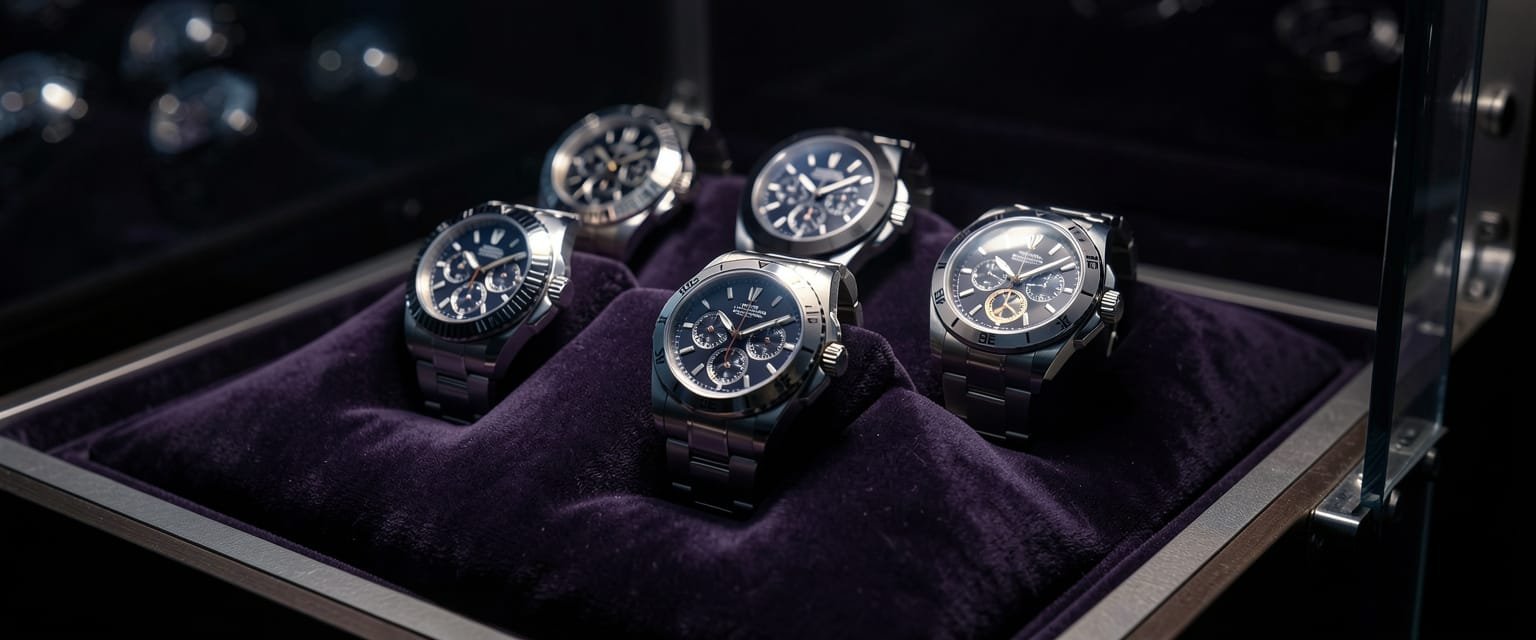

Brew Watches combine New York industrial design, coffee-culture inspiration, compact retro proportions, sapphire crystal, and distinctive mechanical, automatic, and meca-quartz movements.
Brew Watch Co., commonly referred to simply as Brew Watches, is an independent American watch brand founded in 2015 by industrial designer Jonathan Ferrer. Ferrer studied industrial design at the New Jersey Institute of Technology and developed professional experience in the watch industry before launching his own brand. The original idea emerged while Ferrer was working and sketching in cafés around New York City. Rather than treating coffee merely as a graphic theme, he built the brand around the ritual of taking a coffee break — a small interval during the day when people stop, reset, and become more conscious of time. Today, Brew has developed a highly recognizable design language built around compact 1970s-inspired cases, industrial forms, bright colors, sapphire crystal, and subtle references to espresso preparation. Current collections include Metric, Metric Lite, Super Metric, and Retrograph, alongside limited and experimental models such as the 8-Bit, Digital Blend, and Swiss manual-wind Metric.
Brew Watch Co. is a strong example of how an independent microbrand can develop a recognizable identity without relying on traditional luxury-watch heritage. The company is relatively young, but its combination of industrial design, coffee culture, retro aesthetics, and compact proportions has created watches that are immediately identifiable among contemporary enthusiast brands.
Founder Jonathan Ferrer conceived Brew in 2015 while spending time working in New York cafés. He had studied industrial design at the New Jersey Institute of Technology and had already gained experience designing watches for other companies. Watching baristas carefully time espresso shots helped inspire the idea of creating a wristwatch that could connect practical timing with the broader ritual of slowing down for coffee.
The first Brew project launched through Kickstarter in 2015. From the beginning, the company treated the coffee theme more subtly than simply placing cups or beans on the dial. Ferrer instead drew inspiration from espresso machines, café interiors, industrial equipment, warm metallic finishes, and the relationship between coffee preparation and precise timing.
That philosophy remains visible in the modern collection. Brew states that its watches are intended to remind the wearer about the importance of enjoying small moments in time, while details such as highlighted chronograph sectors have genuine functional relationships to espresso preparation.
The Metric has become Brew’s signature design. Its compact television-style case measures approximately 36mm by 41.5mm, deliberately recalling watches from the 1970s rather than following the oversized proportions that dominated much of modern watch design.
Current Metric chronographs use a hybrid VK68 meca-quartz chronograph movement. The movement combines battery-powered quartz timekeeping with a mechanical chronograph module, providing quartz accuracy together with the more tactile operation and rapid reset associated with a mechanical stopwatch.
The Metric’s dial contains one of Brew’s characteristic hidden details. A highlighted timing section identifies approximately 25–35 seconds, corresponding to a common target range for pulling an espresso shot. Someone unfamiliar with the brand can simply read it as an unusual chronograph scale, while an owner understands the coffee reference.
Despite its playful inspiration, the current Metric is built with relatively substantial specifications. Standard references use 316L stainless steel, sapphire crystal, integrated-style steel bracelets, recessed chronograph subdials, and 5 ATM / 50 meters of water resistance. Current U.S. pricing for most Metric chronographs is approximately $475.
The Super Metric retains essentially the same compact case dimensions but pushes the color palette further. Electric Blue, Burnt Orange, Lumina Yellow, and Royal Blue variants use textured dials, contrasting square subdials, colored anodized-aluminum pushers, sapphire crystal, and the same VK68 hybrid chronograph architecture.
Brew has also experimented with case materials. The Metric Titanium replaces stainless steel with titanium for both the case and bracelet, reducing weight while retaining the 36mm form, sapphire crystal, VK68 meca-quartz movement, and 50-meter water resistance. Brew states that the titanium version weighs only 89 grams and is approximately 40% lighter than an equivalent steel configuration.
The Retrograph represents the second major Brew design family. Its case measures approximately 38mm by 41.5mm, giving it a slightly more conventional wrist presence while retaining the rounded rectangular forms associated with 1970s industrial design.
Like the Metric, the Retrograph was developed around timing an espresso shot between approximately 25 and 35 seconds, while its chronograph can also track longer periods up to 60 minutes. Current Retrograph watches use sapphire crystal, 316L stainless steel, quick-release leather straps, 50-meter water resistance, and hybrid meca-quartz chronograph movements.
Dial color is particularly important to the Retrograph. Versions such as Espresso, Technicolor, Cobalt, and Lumint use color combinations inspired by coffee, vintage electronics, and industrial objects rather than conventional monochromatic watch styling. The Lumint goes further by using a fully luminous dial.
Brew frequently produces watches in relatively small quantities and rotates colors in and out of availability. This contributes to the company’s microbrand character: specific references may sell out while the underlying collection continues with new dial treatments or limited editions.
One of the most playful examples is the 8-Bit V2, a limited edition of 300 pieces inspired by 1980s arcade games and early home consoles. It uses a 38mm Retrograph-style steel case, sapphire crystal, a pixel-textured dial, custom pixel-style chronograph details, and a VK64 meca-quartz chronograph movement.
The 8-Bit demonstrates an important aspect of Brew’s design philosophy. Coffee remains the core brand narrative, but Ferrer is willing to combine that theme with other forms of nostalgia such as vintage electronics, arcade games, automobiles, and industrial products rather than rigidly repeating one aesthetic formula.
More recently, Brew expanded the Metric concept with the Digital Blend. This unusual watch combines conventional analog hands with a dedicated digital LED espresso timer.
The Digital Blend includes a 30-second countdown and an animated coffee-cup display designed specifically around espresso preparation. Brew describes it as the first hybrid watch combining classic analog timekeeping with a digital LED espresso timer. Its slightly larger 37.5mm × 43mm steel case retains sapphire crystal and 50-meter water resistance.
The company has also moved significantly beyond quartz chronographs. The Metric Lite introduces a compact automatic mechanical watch built around an exceptionally small 30mm × 34mm case.
Current Metric Lite watches use an automatic 6T27 movement, sapphire crystal, stainless-steel cases and bracelets, applied hour markers, and 50-meter water resistance. Variants include conventional silver-and-black designs as well as decorative natural-material dials such as mother of pearl and tiger eye.
The Metric Lite reflects the broader return of smaller wristwatches. Instead of shrinking an existing chronograph only slightly, Brew reduced the design to dimensions comparable with many vintage watches, making the model suitable for buyers who prefer genuinely compact proportions regardless of gender.
Mechanical watchmaking has reached an even higher level with the Metric Swiss Manual Wind. This model uses the established Swiss Sellita SW210-1 b hand-wound movement, visible through a sapphire exhibition case back.
The SW210-1 provides approximately 42 hours of power reserve, while the removal of automatic winding allows Brew to reduce the Metric case thickness to approximately 8.5mm. The current Copper version combines the movement with a three-dimensional radial dial inspired by the appearance of espresso blooming into a cup.
At $875, the Metric Manual Wind is currently the most expensive regular watch shown in Brew’s U.S. catalog and represents a significant change from the company’s original Kickstarter-era positioning.
It also illustrates how Brew has matured as a brand. Rather than abandoning the accessible meca-quartz models that established its reputation, the company is expanding upward with mechanical watches while retaining the same recognizable Metric architecture.
Sapphire crystal is now a major specification throughout the current collection. Metric chronographs, Retrograph watches, Metric Lite automatics, the Titanium Metric, 8-Bit, and Swiss manual-wind models all use sapphire glass.
Case materials remain primarily 316L stainless steel, with titanium available on selected references. Surface finishing usually combines brushing and polishing to emphasize the industrial geometry of the case and bracelet rather than decorative engraving or traditional luxury finishing.
Water resistance is moderate rather than tool-watch focused. Most current chronographs and compact models are rated to 5 ATM / 50 meters. Brew therefore makes everyday design watches rather than dedicated dive watches.
The brand’s own guidance distinguishes water resistance from waterproofing and recommends avoiding activities such as diving, hot tubs, showers, and saunas even when a watch carries a stated water-resistance rating.
Brew offers a two-year limited warranty against manufacturing defects. Current watches purchased through the brand also have a 14-day return period when returned unworn and in original condition.
Production is international rather than vertically integrated in the traditional manufacture sense. Brew concentrates on design, component specification, testing, and final product development while working with specialist manufacturing partners.
Ferrer’s industrial-design background is central to this model. Brew describes rigorous testing of individual components followed by final hand assembly and additional water-pressure, impact-resistance, and timing checks.
The result is a brand whose value lies primarily in original design rather than proprietary movement manufacturing. The movements are established external technologies, but the cases, dials, bracelets, colors, typography, and functional coffee references are unmistakably Brew.
This distinction becomes particularly clear when comparing Brew with mainstream affordable watch manufacturers. A Citizen or Seiko may provide greater technical breadth and production scale, while Brew offers a much narrower catalog with a stronger emphasis on the personality of one designer.
Among microbrands, the company fits naturally alongside design-driven names such as Autodromo, Studio Underd0g, Lorier, Baltic, Farer, and Nezumi, all of which have developed recognizable aesthetics without competing directly as traditional vertically integrated manufactures.
Brew has also earned attention well outside Kickstarter and microbrand circles. The Metric has become the company’s recognizable signature design, while the brand regularly appears at enthusiast events such as Windup Watch Fair and within broader independent-watch coverage. Ferrer credits the watch enthusiast community with playing an important role in the company’s growth.
In 2026, the Metric Retro Dial was also identified by Brew as a Red Dot Award: Design Concept 2026 recipient, further reinforcing the brand’s emphasis on industrial design.
Current pricing is quite concentrated. Metric Lite automatics and Retrograph chronographs begin around $375, current Metric and Super Metric chronographs generally cost approximately $475, titanium versions around $495, and the Swiss manual-wind Metric reaches $875.
Brew should therefore no longer be treated simply as an inexpensive Kickstarter watch brand. Its modern collection occupies a more established enthusiast space where buyers are paying for original industrial design, controlled production, sapphire crystal, distinctive proportions, and increasingly diverse movement technology.
Positioned within the Mid-Range independent watch segment, Brew Watches are especially attractive to buyers who value compact retro design, unusual color combinations, coffee culture, original microbrand identity, meca-quartz chronographs, and mechanical watches that do not resemble mainstream Swiss or Japanese alternatives.
Price Range: $375 – $875+
Positioning: Mid-Range
Choose a country to explore trusted online stores and authorized retailers where Brew Watches may be available.
Yes. Brew is a respected American independent watch brand known for original industrial design, compact retro proportions, sapphire crystal, distinctive chronographs, and unusually thoughtful coffee-inspired details. Its current range includes meca-quartz, automatic, analog-digital, and Swiss hand-wound watches.
Yes. Brew Watch Co. is the formal brand name, while Brew Watches is commonly used to refer to the company and its products. Both refer to the independent watch company founded by Jonathan Ferrer in 2015.
Brew Watch Co. was founded by Jonathan Ferrer, an industrial designer who studied at the New Jersey Institute of Technology and developed professional watch-industry experience before creating his own brand.
Brew Watch Co. was founded in 2015. The first project launched that year after Jonathan Ferrer developed the idea while working and designing in New York coffee shops.
Founder Jonathan Ferrer developed the brand around the ritual of taking a coffee break and becoming more conscious of small moments in time. Several Brew chronographs also highlight approximately 25–35 seconds on their timing scales, corresponding to a typical espresso-shot extraction window.
Most current Metric chronographs use the VK68 hybrid meca-quartz chronograph movement. Quartz technology controls normal timekeeping, while a mechanical module operates the chronograph, combining quartz accuracy with more mechanical-feeling stopwatch action.
Yes. The Metric Lite is an automatic mechanical collection using the 6T27 movement. Current models use compact 30mm × 34mm cases, sapphire crystal, stainless-steel bracelets, and 50-meter water resistance.
Yes. The Metric Swiss Manual Wind uses the Sellita SW210-1 b hand-wound Swiss movement with approximately 42 hours of power reserve. The movement is visible through a sapphire exhibition case back.
Yes. Most current Metric, Retrograph, Metric Lite, and specialty models provide 5 ATM / 50 meters of water resistance. Brew treats these primarily as everyday watches rather than professional dive watches.
Brew has developed an unusually recognizable identity around coffee culture, industrial design, compact 1970s-inspired case shapes, bright color combinations, and functional espresso-timing references. The company also offers an increasingly diverse range of meca-quartz, automatic, analog-digital, titanium, and Swiss hand-wound watches while preserving the same core design language.