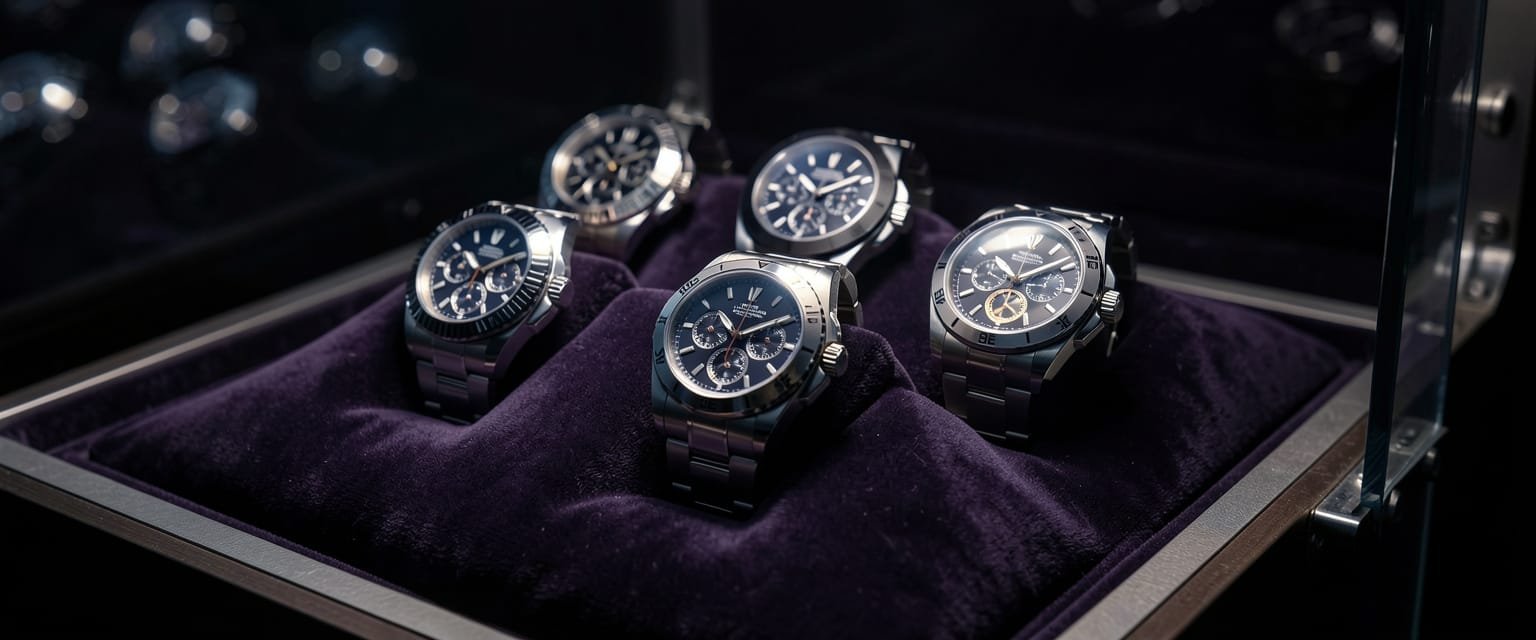
Caravelle Watches combine more than six decades of Bulova heritage with affordable quartz and automatic movements, retro-inspired styling, everyday dress watches, chronographs, and modern sport models.
Caravelle is an American watch brand created by Bulova in 1962 as a more affordable alternative to the company’s main watch line. The original Caravelle collection used jeweled mechanical movements while competing directly with inexpensive non-jeweled watches, giving consumers access to conventional mechanical watchmaking at mass-market prices. The concept proved extremely successful. Bulova reported that Caravelle expanded from only 38 original styles to more than 100 models within a few years, and by 1968 Caravelle had become the best-selling jeweled-movement watch line in the United States by unit volume. Today the brand continues as Caravelle designed by Bulova, offering men’s and women’s watches across Classic, Dress, Modern, Traditional, Sport, Vintage Classic, Light Up, and Sea Hunter collections. Quartz remains the dominant movement type, while current automatic models include the revived Sea Hunter with 200-meter water resistance and 21-jewel mechanical movements.
Caravelle occupies an interesting place within American watch history. It began not as a separate startup or fashion label, but as a deliberate extension of Bulova’s watch business designed to reach buyers who wanted a properly jeweled mechanical watch without paying traditional Bulova prices.
Bulova introduced the Caravelle line nationally in 1962. At launch, watches were priced roughly between $10.95 and $29.95, putting them directly against inexpensive watches that often used simpler non-jeweled movements. The proposition was unusually strong for the period: offer conventional jeweled watch movements at prices accessible to a much wider audience.
Caravelle grew rapidly. A Bulova annual report from the mid-1960s noted that the line had expanded from 38 original models to more than 100 styles, including sports watches, calendar models, diamond watches, pocket watches, and jewelry-oriented pieces. Retail value of Caravelle watches shipped since national distribution began had already exceeded $50 million.
By 1968, Caravelle had become the largest-selling jeweled-movement watch brand in the United States by unit volume. That status continued into the early 1970s, when Bulova still described Caravelle, Bulova, and Accutron as major leaders in their respective price categories.
This history matters because modern Caravelle should not be viewed merely as an inexpensive fashion label borrowing the Bulova name. The brand has existed for more than six decades and was originally a major component of Bulova’s American watch business.
The branding has changed over time. For many years the watches were commonly identified as Caravelle by Bulova. In 2013, Bulova relaunched the line as Caravelle New York, emphasizing New York fashion, seasonal colors, and contemporary styling. The Caravelle New York trademark was registered in 2014, but that specific branding was later discontinued.
The current presentation has returned to the simpler Caravelle name, accompanied by the phrase “designed by Bulova.” Bulova describes the modern line as blending heritage and contemporary design since 1962 with a “retro-cool” aesthetic.
Caravelle therefore remains closely tied to Bulova rather than operating as an independent manufacturer.
Bulova itself has been part of Citizen Watch Group since 2008, when Citizen acquired Bulova Corporation. Caravelle consequently sits within one of the world’s largest watchmaking groups, although the brand maintains a distinct lower-priced identity.
The modern Caravelle catalog is broad.
At the affordable end are Traditional, Dress, Classic, Vintage Classic, and Modern quartz watches, many of which currently retail around $100–$200. Current official U.S. listings include Traditional models around $100–$145, Dress watches around $135–$295, and Modern watches around $175–$250 before promotional discounts.
Quartz movements dominate these everyday collections because they offer accuracy, low maintenance, slim case construction, and lower manufacturing cost.
One example is the Caravelle Vintage Dress 43B176, a 32mm stainless-steel watch powered by the quartz GL12 movement. Bulova specifies accuracy to approximately 15 seconds per month for this caliber. The watch uses mineral crystal and is splash resistant.
Women’s Caravelle watches are especially varied in size.
Current Vintage Classic and Classic designs include extremely petite cases around 18.5–19mm, reflecting the renewed popularity of jewelry-like and mid-century-inspired watches. Some use mother-of-pearl dials, Roman numerals, curved mineral crystals, and stainless-steel expansion bracelets.
Other women’s models use rectangular, oval, traditional round, or jewelry-oriented case shapes. This makes Caravelle unusually broad compared with brands that focus almost entirely on larger sport watches.
The Modern collection generally takes a cleaner contemporary approach. Some references combine black or gold-tone stainless steel with minimalist dials, while selected models include genuine diamond accents. A representative Caravelle Modern reference uses a 40mm stainless-steel case, mineral crystal, quartz movement, and splash resistance.
Dress watches remain one of Caravelle’s strongest traditional categories.
The brand offers simple three-hand quartz watches with leather straps, stainless-steel bracelets, Roman numerals, date displays, sunray dials, and two-tone finishes. Current prices often sit around $120–$200, making them significantly less expensive than most comparable Bulova-branded dress watches.
Caravelle also maintains a substantial Sport collection.
Modern Sport chronographs can include stainless-steel cases, six-hand quartz chronograph displays, timing bezels, luminous hands and markers, date displays, and water resistance ranging from basic splash protection to 100 meters depending on the reference.
The current reference 43B182, for example, uses a 40mm stainless-steel case, mineral crystal, six-hand chronograph display, unidirectional timing bezel, luminous markers, and 100-meter water resistance. Its official price is approximately $275.
The Aqualuxx follows a similar sport-watch formula. Reference 45B161 combines a 44mm stainless-steel case, six-hand quartz chronograph, rotating bezel, mineral crystal, silicone strap, and 100-meter water resistance.
One of the more unusual Caravelle features is the Light Up system.
Selected field and Traditional watches include a dial backlight activated by a pusher. Rather than relying exclusively on luminous paint, pressing the button illuminates the entire dial for easier nighttime reading.
Current Light Up field watches use 316L stainless steel cases, compass-style bezels, large Arabic numerals, day/date displays, pass-through nylon straps, and illuminated dials inspired by vintage American field watches.
This gives Caravelle something uncommon in its price range. Timex is famous for Indiglo illumination, but full-dial lighting remains relatively unusual among traditional analog watch brands.
Mechanical watches have also returned to the contemporary lineup.
Caravelle currently sells Dress and Classic automatic models, but the most significant mechanical collection is the revived Sea Hunter Automatic.
The historical Sea Hunter name has been reworked into a compact modern sports watch.
Current Sea Hunter models use approximately 39mm stainless-steel cases, automatic movements, rotating bezels, luminous hands and markers, and 200-meter water resistance. Some are supplied on steel bracelets, others on rubber straps, and certain versions include an additional strap.
The movement is particularly notable because Bulova identifies it explicitly as the 8215 automatic caliber on current Sea Hunter specifications.
The 8215 is a 21-jewel mechanical automatic movement with approximately 42 hours of power reserve. It is part of the Miyota movement family, which fits naturally within the wider Citizen corporate group.
This makes the Sea Hunter substantially more enthusiast-oriented than the majority of Caravelle’s catalog.
Current Sea Hunter watches also provide 200 meters / 20 bar of water resistance, screw-back cases, rotating one-way bezels, and mineral or double-domed mineral crystals depending on the reference. Official U.S. prices currently range from approximately $375 to $450 before discounts.
The use of mineral rather than sapphire crystal is worth noting.
Mineral crystal remains standard throughout most of the current Caravelle range, including many models priced above $200 and even current Sea Hunter automatics. It provides good impact resistance but is less scratch resistant than sapphire.
Caravelle is therefore not trying to win specification comparisons against enthusiast microbrands offering sapphire and ceramic at similar prices.
Its strength instead comes from the combination of Bulova design infrastructure, established distribution, recognizable heritage, straightforward servicing, accessible pricing, and a very broad range of styles.
Water resistance varies widely and needs to be checked model by model.
Many dress, Classic, Modern, and petite women’s watches are only splash resistant. Sport models may reach 50 or 100 meters, while Sea Hunter automatics provide 200 meters.
Caravelle also benefits from Bulova’s after-sales infrastructure. Current watches sold through Bulova are backed by a three-year limited warranty, a stronger warranty period than many inexpensive fashion-watch brands offer.
Today the catalog contains close to one hundred Caravelle references across men’s and women’s categories. The current U.S. collection spans approximately $100 to $450 at regular retail, with promotional pricing occasionally dropping Traditional and Dress models to around $80.
This puts Caravelle below the main Bulova range while still occupying a step above ultra-budget marketplace brands.
Its closest competitors include Timex, Casio, Citizen, Seiko, Fossil, Skagen, Anne Klein, Armitron, Invicta, and Orient, depending on the type of watch.
The comparison with Bulova itself is particularly important.
Bulova generally offers more ambitious movements, higher-grade collections, sapphire crystal on selected models, Precisionist technology, stronger mechanical offerings, and considerably higher prices.
Caravelle is designed to provide a more accessible entry point into the same broader brand ecosystem.
That role is actually very close to the original 1962 concept.
More than sixty years ago Caravelle succeeded because it gave mass-market buyers a more affordable way to purchase a jeweled watch backed by Bulova. Today it performs essentially the same function through quartz watches, inexpensive automatics, retro designs, and sport models priced below much of the main Bulova range.
Positioned within the Entry Level watch segment, Caravelle Watches are particularly suitable for buyers looking for affordable everyday watches backed by an established company, compact vintage-inspired women’s watches, quartz chronographs, illuminated field watches, or accessible automatic sport watches such as the Sea Hunter.
Price Range: $80 – $450+
Positioning: Entry Level
Yes. Caravelle is a legitimate long-established watch brand created by Bulova in 1962. Its current watches are designed by Bulova and include affordable quartz, automatic, dress, sport, chronograph, field, and vintage-inspired models. Caravelle is best evaluated as an Entry Level brand rather than a luxury watchmaker.
Yes. The current official branding is “Caravelle designed by Bulova.” Caravelle originated as a Bulova watch line in 1962 and remains part of the Bulova brand portfolio today.
Caravelle was introduced by Bulova in 1962. The original watches were designed as affordable jeweled-movement alternatives to inexpensive non-jeweled watches sold at similar prices.
Yes. Caravelle New York was a later branding of the same Bulova-owned Caravelle watch line. Bulova relaunched the brand under the Caravelle New York name in 2013, but current watches are once again sold primarily under the simpler Caravelle name.
Most current Caravelle watches use quartz movements, while selected Dress, Classic, and Sea Hunter watches are automatic. Current Sea Hunter models use a 21-jewel 8215 automatic movement with approximately 42 hours of power reserve.
Yes. Caravelle currently offers automatic watches, including Classic and Dress models and the Sea Hunter Automatic collection. The Sea Hunter combines an automatic movement with 200-meter water resistance and a rotating sports bezel.
Caravelle watches are water resistant rather than universally waterproof. Ratings vary substantially. Many Dress and Classic models are only splash resistant, Sport models may provide 50 or 100 meters, and Sea Hunter automatics provide up to 200 meters / 20 bar.
Most current Caravelle models use mineral crystal rather than sapphire. This includes many quartz watches and current Sea Hunter automatics. Buyers should check each model individually if sapphire crystal is an important requirement.
The Sea Hunter is Caravelle’s current automatic sports-watch collection. Modern versions use 39mm stainless-steel cases, 21-jewel automatic movements with around 42 hours of power reserve, rotating bezels, luminous markers, and 200-meter water resistance.
Both belong to the same broader Bulova organization, but Caravelle is positioned as the more affordable brand. Bulova offers more advanced technologies and higher-priced mechanical and quartz collections, while Caravelle concentrates on accessible everyday quartz watches, fashion and vintage-inspired designs, chronographs, and selected automatics. Caravelle therefore acts as an entry point into the wider Bulova watch portfolio.