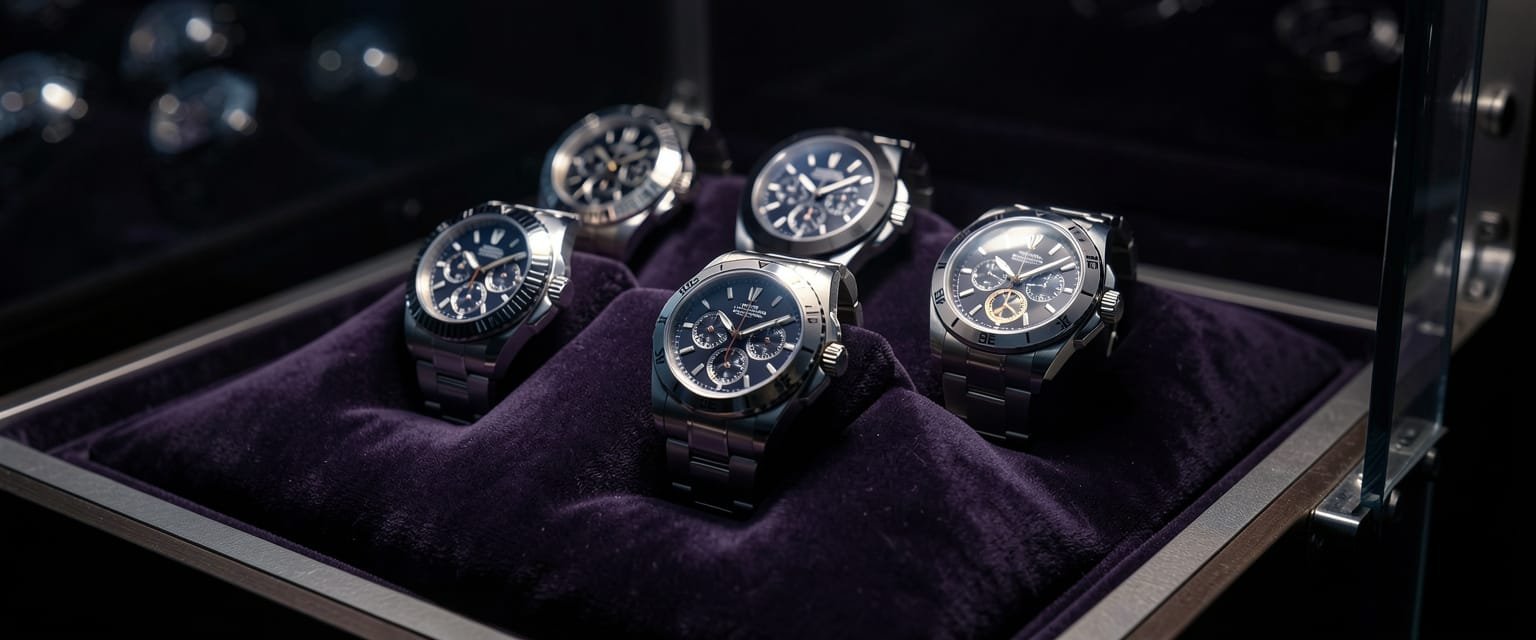
Aragon Watches combine bold American design, robust dive-watch construction, Japanese and Swiss mechanical movements, and unusual materials in accessible enthusiast-focused timepieces.
Aragon is an independent American watch company founded in 1991 by designer Wing Liang together with his sister Angela Liang. Based in Deerfield Beach, Florida, the business originally operated under the Android name before continuing its watchmaking identity as Aragon. Wing Liang remains the company’s founder, CEO, and sole designer. From the beginning, Liang approached watches as expressive industrial objects rather than restrained traditional accessories. His inspiration has included automobiles, machinery, music, science fiction, and everyday industrial forms, producing watches with distinctive cases, colorful dials, oversized dimensions, unconventional bracelets, and mechanical displays. Today, Aragon is best known for affordable automatic and dive watches, large-case designs, extensive use of Japanese and Swiss movements, T-100 tritium illumination, skeleton and open-heart models, meteorite dials, titanium and ceramic construction, and unusually accessible mechanical tourbillons.
Aragon occupies an unusual position within the American enthusiast-watch market. The company offers specifications and mechanical variety normally associated with substantially more expensive watches while maintaining direct-to-consumer pricing that places much of the catalog within reach of entry-level collectors.
Design remains central to the brand. Wing Liang personally designs Aragon watches and has developed a recognizable visual language built around substantial cases, strong geometric shapes, saturated dial colors, complex bracelets, visible mechanics, and oversized crowns and bezels. Although more compact references are available, many collections continue to offer 44mm, 45mm, 48mm, and even 50mm cases.
The Divemaster is one of Aragon’s longest-running and most important collections. The contemporary range is unusually broad, including Japanese automatic, Swiss automatic, GMT, skeleton, titanium, tungsten, meteorite, and central-tourbillon models. Current versions are available in sizes ranging from approximately 40mm to 50mm.
A representative Divemaster 42 uses the Swiss Ronda R150 25-jewel automatic movement, a 42mm stainless-steel case, sapphire crystal with anti-reflective coating, luminous sapphire bezel, screw-down crown, exhibition case back, and 200 meters of water resistance. Other Divemaster references use Japanese Seiko Instruments NH-series movements, including the NH34 GMT, NH35, NH36, NH38 open-heart, and NH72 skeleton calibers.
Aragon frequently uses Japanese mechanical movements because they allow the company to offer automatic watches at relatively accessible prices. The catalog includes calibers from Seiko Instruments and Miyota, ranging from straightforward three-hand NH35 and NH36 movements to skeletonized NH70/NH72 designs and higher-frequency Miyota 9000-series movements.
Swiss movements appear in more specialized models. Current and recent watches have used the Ronda R150, while selected collections incorporate Swiss calibers from manufacturers such as Soprod. This movement variety allows Aragon to create watches at several different price and specification levels rather than tying the entire catalog to one supplier.
The Hercules collection demonstrates the brand’s preference for bold proportions and unusual specifications. Versions include ceramic cases, meteorite dials, Japanese and Swiss automatic movements, GMT configurations, and T-100 tritium illumination. Depending on the reference, Hercules watches may be offered in 44mm or 50mm cases.
Aragon’s T-100 Tritium watches are particularly distinctive within their price category. The Hercules T-100, for example, uses Swiss-made mb-microtec tritium tubes on the dial and hands together with a Japanese NH35 automatic movement and 200-meter water resistance. Unlike conventional luminous paint that must first absorb light, tritium tubes continuously self-illuminate without requiring an external light source.
The brand extends this concept across other collections, including the Parma and selected DF-series watches. These models appeal to buyers who need continuous low-light readability or simply enjoy the unusual appearance of multiple illuminated tubes.
The Antigravity family places greater emphasis on exposed mechanics and unconventional movement architecture. The collection includes skeletonized Japanese automatic movements, dragon-themed designs, and automatic tourbillons. Aragon’s 42mm and 48mm Antigravity Tourbillons use the Chinese HZ3C00 automatic tourbillon movement operating at 28,800 vibrations per hour, combined with curved sapphire crystals and 200-meter water resistance.
Mechanical tourbillons are normally associated with luxury-watch pricing, making Aragon’s approach particularly unusual. Current Antigravity Tourbillon references are listed around $800, illustrating the brand’s strategy of offering mechanically interesting watches without attempting to compete as a traditional haute horlogerie manufacturer.
The Divemaster Central Tourbillon pushes the idea further by combining dive-watch styling with a tourbillon positioned at the center of the dial. Selected 45mm and 50mm versions use the HZ3JZ0E 39-jewel automatic central-tourbillon movement, sapphire crystal, rotating bezels, 200-meter water resistance, and limited numbered production. Some references incorporate meteorite dials or gemstone-set bezels.
Other current families demonstrate the breadth of Wing Liang’s design vocabulary. The Enforcer includes Japanese Miyota automatic and GMT movements; EVO models combine contemporary sports-watch styling with NH35 or Swiss movements; Matador offers compact automatic configurations; and Millipede includes automatic, GMT, tourbillon, and rotating-display variations.
Additional families include Armour, Caprice, Concept S, DF Series, Hiro, Hydraumatic, Parma 2, Regeneron, Sea Charger, Silverjet, Superjet, and Virtuoso. This unusually large collection structure reflects Aragon’s preference for frequent experimentation rather than maintaining only a few permanent watch families.
Material selection is another defining characteristic. Aragon has worked with stainless steel, titanium, ceramic, tungsten, sapphire crystal, K1 hardened mineral crystal, carbon-fiber-style materials, meteorite, mother-of-pearl, gemstones, leather, silicone, and substantial metal bracelets.
Titanium appears frequently in larger models where reducing weight is particularly useful. A 50mm Divemaster Titanium, for example, combines a Japanese NH35 automatic movement with a titanium case, sapphire crystal, ceramic bezel insert, and substantial dive-watch construction while remaining lighter than an equivalent steel watch.
Tungsten has also played an important role in the company’s history. Under its earlier Android identity, Wing Liang released the Virtuoso Tungsten Tourbillon in 2010, a 50mm limited-edition mechanical tourbillon using a tungsten case and a Chinese tourbillon movement. The company described it at the time as the first 50mm tungsten tourbillon watch.
Aragon’s designs tend to favor strong water resistance even when mechanical complexity is involved. Many Divemaster, Hercules, Antigravity, and other sport references offer 200 meters of water resistance, screw-down crowns, rotating bezels, and substantial bracelets. Buyers should nevertheless check each model individually because specifications differ widely across the catalog.
Case size deserves similar attention. Aragon is one of the comparatively few modern watch brands that continues to serve enthusiasts who actively prefer very large watches. While models around 40–42mm are increasingly available, numerous references remain in the 45–50mm range, often with substantial thickness and weight. For buyers with smaller wrists or a preference for restrained proportions, checking dimensions before purchasing is especially important.
The catalog also includes a broad range of dial treatments. Bright blue, purple, green, orange, red, mother-of-pearl, meteorite, skeletonized, open-heart, full-lume, and multicolor designs appear alongside more conventional black, silver, and white configurations. This willingness to use unusual colors is one reason Aragon watches are easy to distinguish from more conservative enthusiast brands.
Aragon sells directly through its own website and frequently offers substantial promotional pricing. Standard automatic watches commonly appear in the roughly $100–$500 range during promotions, while Swiss automatic models and specialized configurations can cost more. Current automatic tourbillons sit around $800, and central-tourbillon Divemaster models can reach approximately $1,200 before discounts.
This aggressive pricing is a major part of the brand’s appeal. Aragon is not attempting to provide handcrafted movements or traditional haute horlogerie finishing. Instead, it concentrates on recognizable design, established third-party movements, ambitious specifications, unusual complications, and substantial material value.
Consumers often choose Aragon because few brands at similar prices offer such a wide combination of automatic movements, sapphire crystals, 200-meter water resistance, titanium, ceramic, tungsten, meteorite, T-100 tritium, skeleton calibers, GMT functionality, and tourbillons.
Positioned within the affordable enthusiast segment, Aragon Watches appeal especially to collectors seeking bold wrist presence, mechanical variety, dive-watch functionality, colorful design, and unusually high specifications for the price.
Price Range: $100 – $1,200+
Positioning: Entry Level
Yes. Aragon is a well-established American enthusiast brand known for bold designs, reliable Japanese and Swiss movements, strong specifications, and comparatively low prices. It is particularly attractive to buyers who value mechanical features and wrist presence more than luxury-brand prestige.
Aragon was founded by Wing Liang and his sister Angela Liang. Wing Liang remains the company’s CEO and sole watch designer, developing designs inspired by machinery, automobiles, music, movies, and other visual influences.
The company traces its history to 1991. It originally produced watches under the Android name and later continued under the Aragon identity while retaining Wing Liang’s design leadership.
Aragon Watches is an American company based in Deerfield Beach, Florida. Its watches use movements and components sourced internationally, including Japanese, Swiss, and Chinese mechanical calibers depending on the model.
Aragon uses a wide variety of third-party movements. Current models include Seiko Instruments NH-series automatics, Miyota 9000-series calibers, Swiss Ronda R150 movements, selected Soprod movements, and Chinese automatic tourbillon calibers. The exact movement should always be checked for the individual reference.
Aragon is best known for bold automatic watches, large dive watches, the Divemaster and Hercules collections, colorful designs, T-100 tritium illumination, titanium and ceramic models, skeleton watches, GMTs, and unusually affordable mechanical tourbillons.
Many Aragon sport watches provide genuine dive-oriented specifications. Numerous Divemaster and Hercules models offer screw-down crowns, rotating bezels, luminous displays, and 200 meters of water resistance. Buyers should verify the exact reference because specifications vary.
Yes. Aragon offers automatic tourbillons in collections such as Antigravity and Divemaster. Current models include conventional-position and central-tourbillon watches using Chinese mechanical tourbillon movements at prices far below traditional Swiss tourbillon watches.
Both brands offer bold watches, large cases, automatic movements, colorful designs, and aggressive pricing. Invicta has much greater global recognition and an enormous catalog, while Aragon is smaller and more closely centered on the distinctive design language of founder Wing Liang, with unusual offerings such as T-100 tritium, central tourbillons, and extensive titanium and tungsten models.
Aragon combines unusually bold original case design with a very broad selection of mechanical technology. Buyers can find Japanese and Swiss automatics, GMTs, skeleton movements, T-100 tritium, meteorite dials, ceramic and titanium construction, 200-meter dive watches, and even automatic tourbillons within one comparatively affordable independent brand.