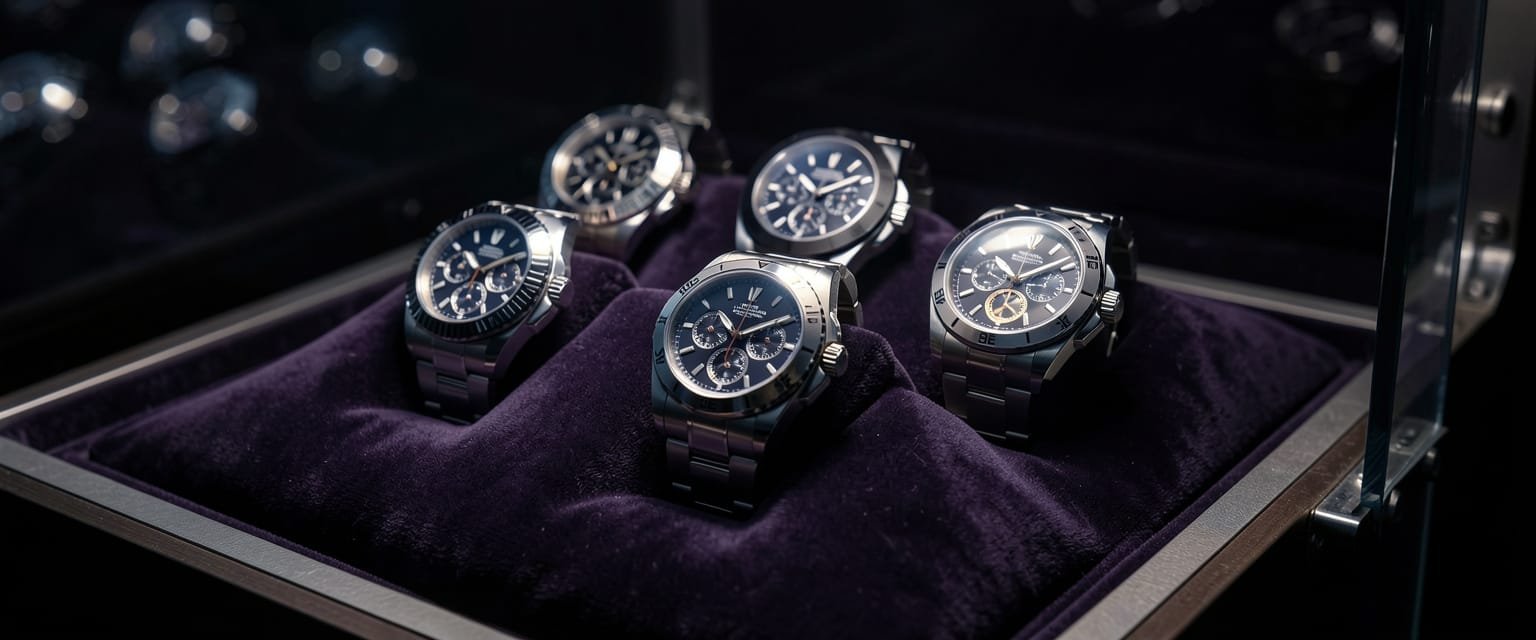

Atlantic Watches combine more than 135 years of Swiss watchmaking heritage with automatic, mechanical, quartz, chronograph, and manufacture-calibre watches led by the iconic Worldmaster collection.
Atlantic Watches traces its history to 1888, when master watchmaker Eduard Kummer established a workshop in Bettlach near Grenchen, Switzerland. Originally known as EKB — Eduard Kummer Bettlach, the company began by producing watch components and supplied established Swiss manufacturers including Longines and Certina. By the end of the nineteenth century, the business had grown from fewer than 20 employees to more than 700. The Atlantic identity emerged later. EKB began producing wristwatch components during the 1920s and introduced watches under the Atlantic name around the beginning of the 1930s, using a sextant as its emblem. In 1953 the company formally adopted the name Atlantic Watch Ltd. Today, Atlantic remains a Swiss Made watch brand offering men’s and women’s collections across automatic, hand-wound mechanical, quartz, chronograph, moonphase, limited-edition, and precious-metal categories. Its best-known family is Worldmaster, complemented by collections including Mariner Wave, Seacloud, Seawave, Seaport, Seabase, Seacrest, Seaflight, Seahunter, Seasport, Timeroy, Grand Prix, and several women’s Elegance lines.
Atlantic has an unusually long history for a watch brand operating primarily within today’s mid-priced Swiss market. Its origins stretch back to the nineteenth-century Swiss watch industry, yet the current company combines that heritage with contemporary automatic watches, quartz models, chronographs, limited editions, and increasingly sophisticated manufacture movements.
The story begins in Bettlach in 1888. Eduard Kummer returned to his home region after developing his watchmaking skills in the Swiss Jura and established a small workshop employing approximately 15 to 20 people. The business expanded rapidly and, before the end of the nineteenth century, employed around 720 workers.
Initially operating as EKB, short for Eduard Kummer Bettlach, the company specialized in watch components rather than building its reputation around a single consumer brand. Its production included components supplied to respected Swiss manufacturers such as Longines and Certina.
During the 1920s EKB expanded into wristwatch production, and in the early 1930s watches carrying the Atlantic name began to appear. The company was also an early producer of water-resistant wristwatches, helping establish the aquatic identity that would remain visible in many later Atlantic collection names.
The company officially became Atlantic Watch Ltd. in 1953. By that point, Atlantic had expanded strongly outside Switzerland, particularly into Central and Eastern Europe. Poland became one of its most important markets, and the brand developed unusually strong recognition there compared with many Western European and North American markets.
One of Atlantic’s most significant technical achievements came in 1960 with the Speed Switch system. According to the company, the mechanism allowed the date indication to change dramatically faster than conventional systems of the period. Atlantic subsequently supplied the innovation to other watch manufacturers, demonstrating that the company’s historical expertise extended beyond styling and assembly.
The Worldmaster collection eventually became Atlantic’s signature watch family and remains the center of the modern catalog. Current Worldmaster watches span simple hand-wound watches, Swiss automatic models, open-heart designs, moonphase watches, chronographs, COSC chronometers, regulator-style displays, pointer-date models, and watches equipped with Atlantic manufacture calibres.
The basic Worldmaster automatic formula is deliberately traditional. A current Worldmaster 1888 Automatic, for example, uses a Sellita SW200-1 automatic movement, stainless-steel case, sapphire crystal, transparent case back, date display, and 50 meters of water resistance. These watches typically favor classical proportions and restrained dial layouts rather than aggressive sports-watch styling.
Atlantic also offers the Worldmaster Original in hand-wound form. Current mechanical versions use vintage-inspired cases and dial designs derived from the brand’s mid-century watches, giving enthusiasts an alternative to modern automatics while preserving the interaction of daily manual winding.
The Worldmaster Art Déco family pushes this heritage styling further. Current automatic models use Swiss Sellita SW200-1 movements, domed sapphire crystals, transparent case backs, and 40mm cases while drawing their visual inspiration from Atlantic designs of the 1950s.
Open-heart designs are another important part of the range. The Worldmaster Open Heart exposes part of its Sellita automatic movement through the dial and case back while retaining the general proportions of a traditional dress watch. Selected versions are produced as limited editions of 888 pieces.
Atlantic has also expanded the Worldmaster family into more elaborate calendar watches. The Nightsky Moonphase uses the Swiss Sellita SW280-1 automatic moonphase movement together with a natural blue aventurine stone dial. The movement operates at 28,800 vibrations per hour and provides approximately 38 hours of running time.
Chronographs represent the upper end of the company’s conventional Swiss-movement range. Worldmaster Prestige models use the respected ETA Valjoux 7750 automatic chronograph caliber, giving Atlantic access to one of the most established mechanical chronograph platforms in Swiss watchmaking.
The modern brand has gone beyond standard outsourced movements through its ATL manufacture calibre program. Atlantic introduced the ATL-1 and ATL-2 mechanical calibres in 2022, followed by the ATL-3 for the company’s 135th anniversary in 2023. These movements are used in limited and higher-end Worldmaster watches.
Current hand-wound Worldmaster models equipped with Atlantic manufacture movements occupy a noticeably higher price level than the standard Sellita-powered watches. The ATL-2 models are currently listed around CHF 1,290, while the ATL-1 limited edition is approximately CHF 1,835 and the ATL-3 135th Anniversary model approximately CHF 2,325.
This development is important for Atlantic’s modern identity. For much of its contemporary history, the company was primarily known for dependable Swiss watches powered by established third-party calibers. The ATL movements allow Atlantic to offer collectors something more distinctive without abandoning the accessible Swiss positioning of the broader collection.
Beyond Worldmaster, Atlantic maintains an extensive selection of sport and everyday watches. The Mariner Wave family includes both automatic and quartz models. A current Mariner Wave Automatic uses a Swiss mechanical movement inside a 42mm steel case and combines a sporty dial with a design intended to work equally well as an everyday watch.
The Seacloud offers a more straightforward quartz proposition. A current 40.5mm Seacloud uses a Swiss Ronda 505 quartz movement, sapphire crystal, stainless-steel case and bracelet, date display, and 100 meters of water resistance. Its CHF 325 retail price illustrates Atlantic’s ability to offer genuine Swiss Made watches well below the pricing of its complicated Worldmaster models.
The Seawave Chrono expands the same idea into an everyday chronograph. Current versions use the Swiss Ronda Z50 quartz chronograph movement together with sapphire crystal, stainless-steel construction, and 100-meter water resistance.
Other modern collections include Seaflight, Seaport, Seabase, Seacrest, Seahunter, Sealine, Seasport, Timeroy, Grand Prix, and Seagold. The catalog therefore covers everything from conservative business watches and vintage-inspired pieces to diving-inspired sports models and contemporary chronographs.
Atlantic also maintains a substantial women’s catalog. Current families include Seacrest Lady XS, Seawave 35mm, Seabase Ladies, Seapair Ladies, Super De Luxe, and multiple Elegance subcollections such as Nightsky, Belle, Classic, Floral, Moonphase, Romantic, and Royal.
Materials depend strongly on the model but frequently include stainless steel, sapphire crystal, PVD finishes, leather straps, stainless-steel bracelets, and natural decorative materials such as aventurine. Selected models incorporate diamonds or gold, while the majority of the range remains focused on practical steel construction.
Sapphire crystal is particularly common throughout Atlantic’s modern catalog. Even comparatively accessible quartz models such as the Seacloud use sapphire, while automatic Worldmaster models frequently combine sapphire fronts with transparent exhibition case backs.
Water resistance spans traditional dress-watch ratings through more robust sports specifications. Many Worldmaster models provide approximately 50 meters, while watches such as the Seacloud and Seawave Chronograph reach 100 meters. Individual sport references may offer still higher ratings, so specifications should be checked for the exact model.
Atlantic’s current retail catalog is unusually broad in price. Quartz watches can begin around the low-to-mid hundreds of Swiss francs, while standard Worldmaster automatic and mechanical watches generally occupy the several-hundred-franc range. Complicated automatic watches, limited editions, manufacture-calibre models, and Valjoux chronographs move beyond CHF 1,000 and frequently above CHF 2,000.
At the upper end, watches such as the Worldmaster Bicompax currently exceed CHF 2,400, while selected automatic moonphase chronographs reach approximately CHF 3,460. This gives Atlantic a much wider pricing spectrum than its reputation as a straightforward mid-range Swiss brand might initially suggest.
The company offers a two-year international warranty, and Atlantic sells watches directly through its official website in addition to maintaining a network of authorized partners.
Atlantic’s strongest markets historically have included Poland and other parts of Central and Eastern Europe, which helps explain why the brand can be extremely familiar to European collectors while remaining comparatively obscure among many U.S. watch buyers.
For collectors, that relative lack of global mainstream recognition can make Atlantic particularly interesting. The brand offers genuine Swiss heritage, recognizable mid-century designs, established Swiss calibers, sapphire crystals, modern manufacture movements, and a catalog with far greater mechanical diversity than many similarly priced fashion-oriented Swiss labels.
Atlantic does not occupy the same market position as Rolex, Omega, or other internationally dominant luxury manufacturers. Its closest competitors are more likely to include accessible and mid-range Swiss brands such as Tissot, Certina, Roamer, Edox, Glycine, and Mido.
Within that segment, Atlantic’s strongest differentiators are its history dating to 1888, the enduring Worldmaster identity, unusually strong recognition in Central and Eastern Europe, and its recent return to proprietary mechanical calibres.
Positioned within the mid-range Swiss watch segment, Atlantic Watches are particularly relevant for buyers seeking authentic Swiss Made construction, automatic and hand-wound mechanical options, traditional styling, strong value, and a historic brand that sits somewhat outside the most familiar mainstream Swiss names.
Price Range: $300 – $3,500+
Positioning: Mid-Range
Choose a country to explore trusted online stores and authorized retailers where Atlantic Watches may be available.
Yes. Atlantic is a historic Swiss watch company with roots dating to 1888. Modern watches offer Swiss Made construction, sapphire crystals on many models, established Swiss automatic and quartz movements, and increasingly sophisticated manufacture-calibre watches.
Yes. Atlantic is a Swiss watch brand whose history began in Bettlach, Switzerland, in 1888 with the company founded by watchmaker Eduard Kummer. Modern Atlantic watches continue to be marketed as Swiss Made.
Atlantic traces its origins to 1888, when Eduard Kummer established EKB — Eduard Kummer Bettlach. Watches carrying the Atlantic name appeared in the early 1930s, and the company was renamed Atlantic Watch Ltd. in 1953.
Atlantic is best known for the Worldmaster collection, which has become the brand’s signature family. Current Worldmaster models include automatic, hand-wound, chronograph, moonphase, open-heart, COSC chronometer, pointer-date, regulator, and manufacture-calibre watches.
Atlantic uses several Swiss movement families depending on the model. Current watches include Sellita SW200-1 and SW280-1, Swiss Ronda quartz movements, ETA Valjoux 7750 chronographs, and Atlantic’s own ATL-series manufacture mechanical calibres.
Yes, on selected watches. Atlantic introduced its modern ATL-1 and ATL-2 manufacture calibres in 2022, followed by the ATL-3 in 2023. Most of the wider collection continues to use proven Swiss movements from suppliers such as Sellita, ETA, and Ronda.
Yes. Automatic watches are a major part of the current Atlantic catalog, with more than 90 automatic references listed by the brand. Collections include Worldmaster, Mariner Wave, and numerous limited and specialty models.
Yes, but the rating depends on the model. Many Worldmaster dress watches offer around 50 meters of water resistance, while models such as the Seacloud and Seawave Chronograph provide 100 meters. Buyers should check the specifications of the individual reference.
Both are historic Swiss brands offering quartz and mechanical watches at accessible-to-mid-range prices. Tissot has significantly greater international distribution and benefits from Swatch Group technology and scale, while Atlantic is smaller, more independent in character, particularly associated with the Worldmaster collection, and now offers selected proprietary ATL manufacture mechanical calibres.
Atlantic combines genuine history dating to 1888, a recognizable Worldmaster design tradition, established Swiss movements, strong Central and Eastern European heritage, and its modern ATL manufacture-calibre program. This gives the brand an unusual mix of accessible Swiss watches and more enthusiast-oriented mechanical models within the same catalog.