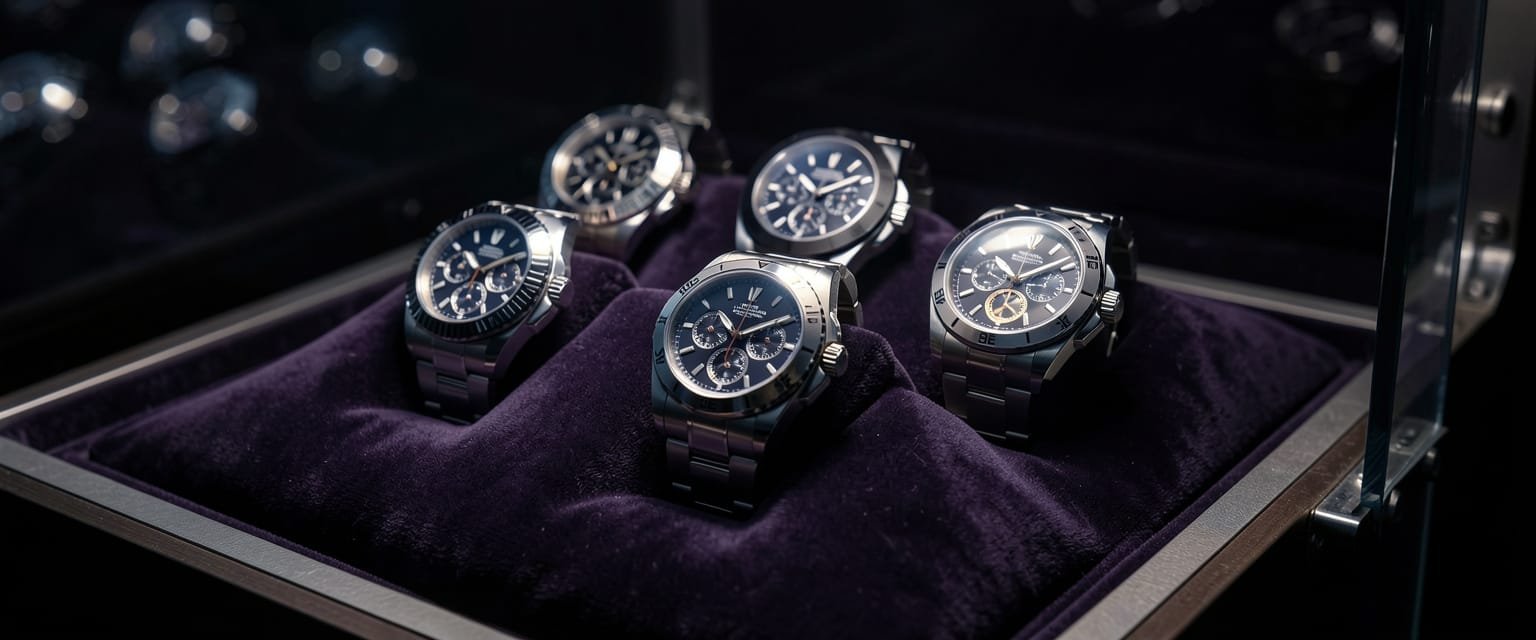

Benyar Watches offer affordable automatic, quartz, chronograph, skeleton, and sports-inspired timepieces designed for buyers seeking maximum visual variety at entry-level prices.
BENYAR is a Chinese watch brand associated with Guangzhou PAGANI DESIGN Watch Industry Co., Ltd., a Guangdong-based watch manufacturer established in 2012. The manufacturer identifies BENYAR and PAGANI DESIGN as separate watch brands within its production portfolio, while the BY BENYAR trademark is registered for wristwatches and other horological products. BENYAR focuses primarily on affordable men’s watches, with collections covering quartz chronographs, conventional three-hand quartz models, automatic mechanical watches, skeleton designs, and sports-inspired pieces. Current direct-store pricing commonly falls around $50–$100, placing the brand firmly within the entry-level segment. Specifications vary considerably between models. Depending on the reference, buyers may find stainless-steel or alloy cases, Hardlex or sapphire crystal, Japanese or unspecified quartz movements, automatic mechanical movements, and water-resistance ratings ranging from basic everyday protection to 10 ATM on selected watches.
BENYAR operates in one of the most competitive areas of contemporary watchmaking: the highly affordable Chinese watch market. Its strategy is straightforward — offer a large variety of visually distinctive watches, including quartz chronographs and mechanical automatics, at prices accessible to buyers who may be purchasing their first traditional wristwatch or first mechanical watch.
The brand is connected with Guangzhou PAGANI DESIGN Watch Industry Co., Ltd., a professional watch manufacturer based in Guangdong, China. The company states that it was founded in 2012 and explicitly identifies both PAGANI DESIGN Watches and BENYAR Watches among the products it manufactures.
This relationship is useful for understanding BENYAR. BENYAR and PAGANI DESIGN should not be merged into a single consumer brand, but they clearly share part of the same manufacturing and retail infrastructure.
The distinction is also reflected in positioning. PAGANI DESIGN generally targets the slightly more enthusiast-oriented end of affordable Chinese watches, frequently emphasizing sapphire crystal, ceramic bezels, Japanese automatic calibers, and stronger sports-watch specifications.
BENYAR usually occupies the more economical end of the spectrum. Its watches rely more heavily on straightforward quartz movements, inexpensive mechanical movements, Hardlex-style mineral crystal, alloy or stainless-steel cases, and familiar sports- or luxury-inspired design cues.
The BY BENYAR name is also a registered trademark. U.S. trademark records identify Ye Yingbin as the owner of the registered BY BENYAR mark covering wristwatches, watch cases, watch bands, watch chains, watch glasses, and related horological products. The international filing dates to 2017, with U.S. registration completed in 2018.
A newer BY BENYAR trademark application filed in 2024 likewise covers watches, automatic watches, sports watches, straps, chains, and clasps, reinforcing BENYAR’s identity as a distinct watch brand rather than simply a model name within PAGANI DESIGN.
The current BENYAR catalog is particularly broad for such an inexpensive brand. Official collection pages divide products into BENYAR Quartz Wristwatch, BENYAR Quartz Chronograph, and BENYAR Mechanical categories.
Quartz chronographs form one of the largest and most recognizable groups.
A representative example is the BENYAR BY-5220, currently priced around $70 through the brand’s direct storefront. It combines a Japanese-origin quartz movement with chronograph functionality, a stainless-steel bracelet, Hardlex crystal, an alloy case, and 5-bar water resistance.
This model demonstrates an important point about BENYAR: specifications should always be checked individually.
A product can have a stainless-steel bracelet without having a stainless-steel case. Likewise, a watch can visually resemble a more expensive sports chronograph while using a comparatively inexpensive alloy case and mineral-based crystal.
Other chronographs use somewhat different construction.
The BY-5192, for example, combines quartz chronograph functionality with Hardlex crystal and sporty styling, while other BENYAR models offer leather or silicone straps instead of steel bracelets.
The BY-5104 follows the classic BENYAR formula of a large sports-oriented quartz chronograph, luminous elements, calendar functionality, Hardlex crystal, and relatively modest everyday water resistance.
BENYAR frequently uses marketing terms such as “luxury,” “sports,” and occasionally “diver.” Buyers should interpret those terms as styling descriptions rather than indications that a watch meets luxury-watch or professional-diving standards.
The brand’s own current product descriptions sometimes clarify this distinction. The BY-5151, for example, may carry diver-style language but is rated to only 3 ATM, and BENYAR explicitly notes that the watch is not suitable for professional diving.
That transparency is useful because water-resistance ratings vary substantially across the collection.
Many basic models provide 3 ATM / 30 meters, which should primarily be regarded as protection against everyday splashes and rain.
Other references move to 5 ATM / 50 meters. The BY-5205, for example, uses Hardlex crystal, a leather strap, quartz movement, and 5 ATM water resistance.
At the upper end, selected BENYAR watches reach 10 ATM / 100 meters.
One of the more interesting examples is the BY-5185 automatic. It uses a compact 39mm stainless-steel case and bracelet, supports both automatic and manual winding, and is rated to 10 ATM. Current direct pricing is approximately $80.
That model illustrates one of BENYAR’s greatest attractions: mechanical watches at extremely low prices.
A conventional automatic wristwatch from a mainstream Japanese or Swiss manufacturer generally costs substantially more. BENYAR allows a buyer to experiment with mechanical timekeeping for less than the price of many mainstream quartz watches.
The BY-5121 is another well-known mechanical option.
It combines an automatic movement with a skeleton-style design that exposes part of the mechanism through the dial. The current version uses a large approximately 45mm stainless-steel case, leather strap, luminous hands, and 3-bar water resistance. Direct pricing is approximately $90.
Skeleton watches are especially effective at this price level because they offer an immediately visible distinction from inexpensive quartz watches.
A first-time mechanical-watch buyer can actually see parts of the mechanism moving without spending hundreds or thousands of dollars on a traditional skeletonized Swiss watch.
The trade-off is movement pedigree.
BENYAR does not consistently identify precise caliber numbers for every mechanical reference. Many product descriptions simply state automatic mechanical rather than identifying a movement such as a Seiko NH35, Miyota 8215, or Sea-Gull caliber.
That means BENYAR is generally better evaluated on basic functionality and purchase price than on movement collectibility.
The same variation exists in quartz watches.
Some current references specifically advertise Japanese quartz movements, while others simply state quartz without providing an identifiable caliber.
For example, BENYAR describes the BY-5220 as using a Japanese-origin quartz movement.
The brand has also experimented with watches combining analog displays with additional functionality and unusual dial layouts.
This broad approach means BENYAR is not really a specialist in any single watch category. It sells inexpensive interpretations of numerous popular styles: business watches, sports chronographs, skeleton automatics, integrated-bracelet designs, racing-inspired watches, and dive-style models.
Case sizes tend to favor modern masculine proportions.
Many BENYAR watches sit approximately in the 40–45mm range, although compact models exist. The BY-5185 is particularly notable at approximately 39mm, making it relatively restrained compared with many of the brand’s larger chronographs.
Materials are equally varied.
Hardlex-style crystal is one of the most common specifications throughout the catalog. It offers better everyday practicality than basic acrylic while keeping manufacturing costs much lower than premium sapphire.
Selected BENYAR references nevertheless advertise sapphire crystal.
The current BY-5206, for example, is sold with sapphire crystal and a stated 10-bar water-resistance rating on its official product page.
This is exactly why BENYAR specifications should not be generalized too broadly. Sapphire exists within the collection, but it is not a universal brand feature.
The same applies to case construction.
Some watches use stainless steel, while others use alloy. Buyers comparing two visually similar models should therefore inspect the exact specifications rather than choosing only by dial design.
Bracelet and strap options include stainless-steel bracelets, genuine or advertised leather straps, silicone straps, and rubber-style sports straps.
Luminous hands are also common, particularly on sports-oriented references.
Current BENYAR pricing remains one of the strongest reasons to consider the brand.
The direct catalog currently lists models such as the BY-1659 at approximately $50, BY-5114 around $55, multiple chronographs around $60–$70, BY-5208 around $80, BY-5121 around $90, and some models around $100.
Marketplace pricing can be even lower during promotions.
For ShopGuruUS purposes, this places BENYAR solidly within Entry Level, below enthusiast-focused Chinese brands such as San Martin and generally below PAGANI DESIGN.
Its closest competitors are brands such as LIGE, NAVIFORCE, POEDAGAR, CURREN, CADISEN, and selected lower-priced watches from PAGANI DESIGN, Addiesdive, Tandorio, and Steeldive.
Comparing BENYAR directly with PAGANI DESIGN is particularly useful.
PAGANI DESIGN typically spends more of the product budget on enthusiast specifications. Current PAGANI models on the same retail platform advertise features such as Seiko NH35 automatic movements, sapphire crystal, stainless-steel construction, ceramic bezels, and 100–200m water resistance.
BENYAR generally sacrifices some of those specifications to keep prices lower.
A BENYAR may therefore use Hardlex where a comparable PAGANI DESIGN uses sapphire, or an alloy case where the more expensive watch uses full stainless steel.
That does not necessarily make BENYAR poor value.
A watch costing approximately $50 should not be assessed using the same expectations as a $500 enthusiast watch or a $5,000 Swiss luxury watch.
At its intended price, BENYAR offers a great deal of visual choice and functionality.
For buyers interested in trying an automatic watch for the first time, an inexpensive BENYAR skeleton can provide the basic experience of wearing and winding a mechanical watch without a large financial commitment.
For someone who simply wants an inexpensive sports chronograph, the brand provides dozens of options at prices low enough that design can be the primary deciding factor.
The limitations are equally clear.
Movement information is not always detailed, finishing is built to a budget, specifications vary from one reference to another, and original design is generally less important than adapting recognizable trends from the wider watch industry.
Buyers should also resist equating the frequent use of the word “luxury” in product titles with actual luxury-watch positioning.
BENYAR is not a luxury watch brand. It is an affordable mass-market Chinese brand.
That is not a criticism — in fact, correctly identifying the segment makes the products easier to evaluate fairly.
After-sales coverage is appropriate for the price class. The current direct store advertises a one-year warranty, free returns with a 30-day window, and worldwide shipping.
For an inexpensive quartz watch, long-term ownership is straightforward: battery replacement and basic strap maintenance may be all that is required.
Mechanical models are different. Because the value of the entire watch can be lower than the cost of professional mechanical servicing in the United States or Europe, major movement repair may not always be economically practical.
That is a normal consideration for ultra-affordable mechanical watches and not unique to BENYAR.
Overall, BENYAR makes the most sense for buyers who understand the category.
It offers quartz chronographs, automatic watches, skeleton designs, sports styling, stainless-steel and alloy options, Hardlex and occasional sapphire crystal, and water resistance ranging from basic splash protection to 10 ATM at very low prices.
Its appeal is not heritage, proprietary watchmaking technology, hand-finishing, or investment value.
The appeal is simple: a lot of watch for relatively little money.
Positioned firmly within the Entry Level market, Benyar Watches are particularly relevant to budget-conscious buyers looking for an inexpensive mechanical watch, quartz chronograph, skeleton design, or sports-inspired everyday watch without stepping into mainstream Japanese or Swiss pricing.
Price Range: $30 – $120+
Positioning: Entry Level
BENYAR can be a good value for buyers looking for inexpensive quartz or mechanical watches. The brand offers chronographs, automatic watches, skeleton models, and sports-inspired designs at very accessible prices. Quality and specifications vary by model, so buyers should compare the movement, case material, crystal, and water-resistance rating of the exact reference they are considering.
Yes. BENYAR is associated with Chinese watch manufacturing in Guangdong. Guangzhou PAGANI DESIGN Watch Industry Co., Ltd. identifies BENYAR among the watch brands it manufactures alongside PAGANI DESIGN.
BENYAR is generally associated with 2012, the year its Guangdong manufacturing company states it was founded. The public historical documentation for BENYAR itself is limited compared with older watch brands, while the BY BENYAR international trademark filing dates to 2017.
No. BENYAR and PAGANI DESIGN are marketed as separate watch brands, although they are closely connected through the same Chinese manufacturing organization. Guangzhou PAGANI DESIGN Watch Industry Co., Ltd. explicitly lists both PAGANI DESIGN Watches and BENYAR Watches separately.
Yes. BENYAR sells automatic mechanical watches including models such as the BY-5121 and BY-5185. The BY-5121 uses an automatic movement with skeleton styling, while the BY-5185 supports automatic and manual winding.
BENYAR uses both quartz and mechanical movements. Some quartz models are specifically described as using Japanese-origin movements, while many mechanical models are listed simply as automatic without an exact caliber number. Movement details should therefore be checked for each individual model.
Some do, but sapphire crystal is not standard across the entire BENYAR collection. Many models use Hardlex-style crystal, while selected watches such as the current BY-5206 are advertised with sapphire crystal.
BENYAR watches are water resistant rather than universally waterproof. Ratings vary by model. Some watches provide only 3 ATM, many offer 5 ATM, and selected models such as the BY-5185 are rated to 10 ATM. Buyers should use the rating of the exact model rather than assuming sports or diver-style watches are suitable for diving.
Most BENYAR watches are very affordable. Current direct-store models commonly sell for about $50–$100, while marketplace discounts can push some references below that range. Automatic, chronograph, and higher-specification models generally cost more than basic quartz watches.
BENYAR benefits from Guangdong’s large-scale watch manufacturing and component supply network and uses cost-conscious materials and externally sourced quartz or mechanical movements. Many watches use Hardlex crystal, alloy or stainless-steel cases, and mass-production techniques rather than proprietary calibers or high-end hand finishing. This allows BENYAR to offer mechanical and chronograph watches at very low retail prices.