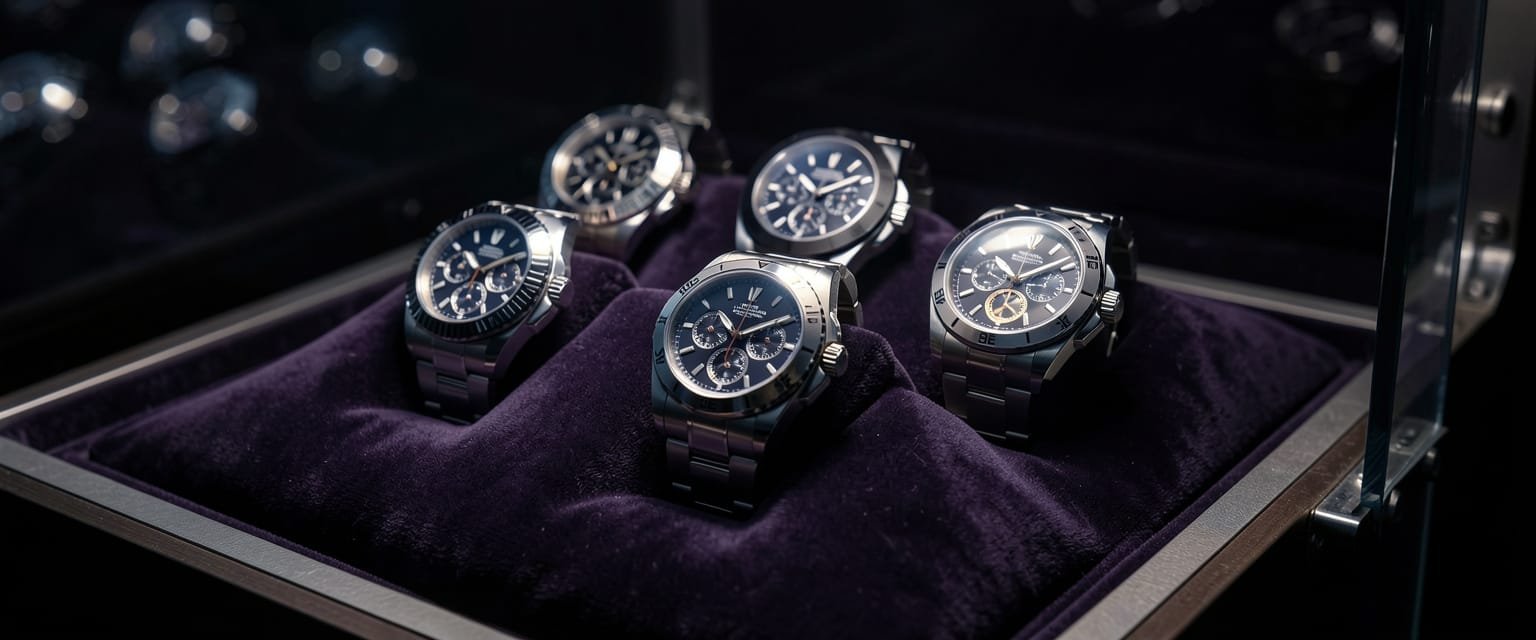

Buren Watches represent an important chapter in Swiss watchmaking history, renowned for ultra-thin micro-rotor automatic movements, Super Slender watches, and technology that helped make the automatic chronograph possible.
Buren Watch Company was established in 1898 in Büren an der Aare, Switzerland, after the British watch company H. Williamson Ltd. acquired the local manufacturer Fritz Suter & Cie. The Swiss factory initially produced pocket watches, clocks, movements, and components before developing into a significant manufacturer in its own right. The company became particularly important during the twentieth century for its work on automatic movements. Its greatest technical achievement was a compact oscillating weight integrated into the plane of the movement rather than mounted above it. Hans Kocher filed the relevant Swiss patent in 1954, and Buren later commercialized the technology in its exceptionally thin Super Slender automatic watches. Buren was acquired by Hamilton Watch Company in 1966, and its thin automatic technology later became the base for the famous Calibre 11 Chrono-Matic project developed with Hamilton, Heuer, Breitling, and Dubois-Dépraz. The historic Buren operation ended in 1972, making original Buren watches primarily a vintage collector category today.
Buren is one of those historical Swiss watchmakers whose importance is much greater than its present-day name recognition might suggest. The company disappeared during the restructuring and upheaval of the Swiss watch industry in the early 1970s, but several of its technical developments remain highly relevant to modern mechanical watchmaking.
The company’s roots begin in the Swiss town of Büren an der Aare in the canton of Bern. In 1898, London-based H. Williamson Ltd. acquired Fritz Suter & Cie and developed the operation into a Swiss manufacturing base producing pocket watches, clocks, movements, and related components. By the early twentieth century, the factory had become a substantial industrial watchmaking operation.
The Buren Watch Co. name began appearing during the Williamson period, and after financial problems affected the British parent company, the Swiss factory continued under new ownership. By 1932, Buren had effectively become independent, beginning a period of increasingly ambitious movement development.
Automatic winding became one of Buren’s principal areas of experimentation. Earlier watches used bumper-style automatic movements, while later Rotowind calibers employed more conventional full rotors. These developments eventually led to the innovation for which the company is best remembered.
Traditional automatic movements place a large oscillating rotor above the movement. This creates an efficient winding system, but it also increases the overall thickness of the watch.
Engineer Hans Kocher, working at Buren, developed a different architecture. His design used a much smaller oscillating weight recessed into the same horizontal plane as the movement itself. The Swiss patent application was filed in 1954, giving Buren one of the earliest legally documented claims to what is now universally called the micro-rotor.
The terminology was somewhat different at the time. Buren referred to the mechanism as a planetary rotor, while Universal Genève popularized the word “Microtor.” Both companies were developing very similar concepts during the 1950s, and the history is sometimes simplified into a debate over which company invented the micro-rotor first.
The patent record is particularly significant: Buren’s Hans Kocher filed Swiss patent CH329804 before Universal Genève’s corresponding filing. Both companies ultimately produced successful commercial micro-rotor movements, and both deserve an important place in the history of ultra-thin automatic watches.
Buren’s first production micro-rotor family appeared as the Calibre 1000 around 1957–1958. The movement powered watches sold under the Super Slender name and allowed Buren to create automatic wristwatches that were remarkably thin for their period.
The Super Slender became one of the company’s signature products. Many surviving examples use modest case diameters around 33–35mm, reflecting mid-century proportions, and can be found in stainless steel, gold-filled, gold-plated, and solid-gold configurations.
Micro-rotor watches are particularly attractive to collectors because the movement architecture remains visually unusual even by modern standards. Rather than covering much of the movement with a large central rotor, the smaller winding mass sits partially recessed within the bridges, leaving more of the mechanical structure visible.
Buren continued refining the concept through later calibers including the 1280, 1281, 1320, and 1321 families. These movements were associated with names such as Intra-Matic and later became important outside Buren itself.
Movement technology was also supplied or licensed to other manufacturers. Buren micro-rotor calibers appeared in watches from companies including Hamilton and Bulova, while the underlying technology influenced the broader development of thin automatic watches.
This relationship with Hamilton became much deeper in 1966, when Hamilton Watch Company acquired Buren. The acquisition gave the American company access not only to Swiss production capacity but also to Buren’s movement engineering and micro-rotor technology.
Hamilton subsequently used Buren movements in watches including the Thin-O-Matic and Intra-Matic families. Some Buren calibers were re-designated under Hamilton movement numbers, creating a particularly interesting overlap between the two companies for vintage-watch collectors.
The acquisition also placed Buren at the center of one of the most important races in twentieth-century mechanical watchmaking: the development of the automatic chronograph.
Until the late 1960s, chronograph wristwatches were primarily manually wound. Adding automatic winding to a chronograph presented an engineering challenge because conventional automatic rotors occupied space above the movement — exactly where an additional chronograph mechanism would normally need to sit.
Buren’s thin micro-rotor architecture offered an elegant solution.
The project that became known internally as Project 99 brought together Buren/Hamilton, Heuer, Breitling, and chronograph specialist Dubois-Dépraz. A modified Buren micro-rotor automatic caliber acted as the base movement, while Dubois-Dépraz developed the chronograph module mounted above it.
The resulting Calibre 11 Chrono-Matic appeared in 1969 and became one of the first commercially available automatic chronograph movements. It competed directly with Zenith’s El Primero and Seiko’s 6139 during the historic race to bring the self-winding chronograph to market.
The Calibre 11 has a particularly recognizable configuration because its crown sits on the left side of the case, while the chronograph pushers remain on the right. This unusual layout results directly from the architecture of the Buren automatic base movement combined with the modular chronograph mechanism.
Calibre 11 and its later variations appeared in historically important watches from Heuer, Breitling, and Hamilton, meaning that Buren technology sits inside some of the most collectible sports chronographs of the late 1960s and early 1970s.
Buren itself produced considerably more than micro-rotor watches. Vintage examples include conventional manual-wind watches, full-rotor automatics, chronographs, dress watches, military-style watches, ladies’ watches, pocket watches, and models bearing names such as Grand Prix, Super Slender, Intra-Matic, and Starlite.
The Grand Prix name appears frequently on surviving Buren watches, including some of the brand’s most desirable micro-rotor models. Condition, case material, dial originality, movement type, and service history all have major effects on collector value.
Vintage Buren pricing therefore varies enormously. Simple manually wound pieces can occasionally be found at relatively modest prices, while good micro-rotor watches are usually more valuable. Recent listings for Super Slender and Grand Prix micro-rotor watches commonly sit around several hundred dollars, with gold examples and unusual chronographs reaching significantly higher levels.
The Buren micro-rotor deserves particular attention when buying. Because these movements are now many decades old and were produced by a company that no longer manufactures replacement components, proper servicing can require a watchmaker familiar with vintage Swiss movements.
Buyers should therefore prioritize movement condition over superficial cosmetic perfection. A freshly polished case with an unserviced or damaged micro-rotor caliber may ultimately be a worse purchase than a cosmetically aged watch with an original, professionally serviced movement.
Originality matters as well. Dials on vintage watches were frequently refinished during past servicing, while replacement crowns, hands, crystals, and movements can affect collector interest.
Water resistance should never be assumed on an original Buren simply because the watch may once have been marketed as water resistant. Gaskets, crowns, case tubes, and crystals can deteriorate substantially over fifty or sixty years.
The Buren story effectively ended as a major Swiss manufacturer during the early 1970s. After Hamilton’s acquisition and subsequent industry restructuring, the original factory operation was liquidated in 1972.
This historical break is important because modern watches carrying the Buren name should not automatically be treated as a continuous product line from the original 1898 Buren Watch Company.
Various later businesses have used or held rights to the name. Historical watch references describe a later German operation associated with Schweizer Uhren Editionen in Hamburg, while a current Egyptian business markets Buren watches locally and states that it has held exclusive Egyptian rights since approximately 2000–2001.
The current Egyptian operation offers inexpensive contemporary watches using Japanese movements in collections including Classique, Forged, and Element. Its own website explicitly emphasizes Japanese movement technology and Egyptian distribution.
For collectors, however, the term Buren Watches continues to refer primarily to the historic Swiss manufacturer and its vintage mechanical output rather than these later regional products.
That historical company deserves considerably more recognition than it currently receives. Buren was not simply another small Swiss brand that disappeared during the quartz crisis. It produced its own movements, pioneered one of the major architectures of thin automatic watchmaking, supplied technology to other manufacturers, and became integral to the development of the automatic chronograph.
Its closest historical comparison is probably Universal Genève, because both companies were early pioneers of integrated micro-rotor technology. Universal Genève is much more widely recognized among modern collectors, which can make Buren watches comparatively attractive in terms of value.
Buren is also deeply connected with Hamilton through the 1966 acquisition and with Heuer and Breitling through the Calibre 11 project.
For enthusiasts who enjoy historically important movements but do not want to pay the premiums associated with Patek Philippe, Universal Genève, or high-end modern micro-rotor watches, a vintage Buren Super Slender or Grand Prix can provide a fascinating entry into the technology.
The combination of historical importance, relatively modest current recognition, authentic Swiss movement manufacture, and genuinely innovative engineering makes Buren particularly interesting within the vintage market.
Positioned today primarily within the Mid-Range vintage collector segment, Buren Watches appeal to enthusiasts seeking mid-century Swiss design, unusual automatic movements, early micro-rotor engineering, and a direct technological connection to one of the most important automatic chronograph developments of the twentieth century.
Price Range: $100 – $1,500+
Positioning: Mid-Range
Yes — historically, Buren was a serious Swiss movement manufacturer rather than simply a fashion-watch label. The company developed its own mechanical and automatic calibers and became particularly important for its pioneering integrated micro-rotor technology. Original Buren watches are now primarily vintage collector pieces.
The historic Buren Watch Company was Swiss, based in Büren an der Aare in the canton of Bern. It was established there in 1898 and produced watches and movements in Switzerland until the original operation ended in 1972.
Buren Watch Company dates to 1898, when British company H. Williamson Ltd. acquired Fritz Suter & Cie in Büren an der Aare and developed the site as a Swiss watchmaking operation.
Buren is best known for developing ultra-thin automatic movements using an integrated micro-rotor, particularly the Super Slender family. Buren technology later formed the automatic base of the Calibre 11 Chrono-Matic project.
Buren was one of the principal pioneers of the concept. Engineer Hans Kocher filed Buren’s Swiss patent for an integrated planetary rotor in 1954, before Universal Genève’s corresponding filing. Both companies subsequently became major early producers of micro-rotor automatic watches.
The Super Slender was Buren’s famous line of ultra-thin automatic watches powered by compact micro-rotor movements. By integrating the winding rotor into the movement rather than placing it above the mechanism, Buren could produce significantly thinner automatic watches.
Hamilton Watch Company acquired Buren in 1966. Hamilton subsequently used Buren movements in several watches and relied on Buren’s micro-rotor technology during development of the automatic Calibre 11 Chrono-Matic chronograph.
Yes. Buren/Hamilton participated with Heuer, Breitling, and Dubois-Dépraz in Project 99, which produced the Calibre 11 Chrono-Matic in 1969. A thin Buren micro-rotor automatic movement served as the base beneath the chronograph module.
The original Swiss Buren Watch Company ceased operations in 1972. Watches using the Buren name have appeared under later ownership and regional businesses, including a current Egyptian operation, but buyers should not assume these modern products represent uninterrupted production by the original historic Swiss manufacturer.
Yes. Vintage Buren watches are especially attractive to collectors interested in micro-rotor movements, thin automatic watches, and the history of the automatic chronograph. Super Slender and Grand Prix micro-rotor models are among the most recognizable, while condition, originality, case material, movement type, and service history strongly influence value.