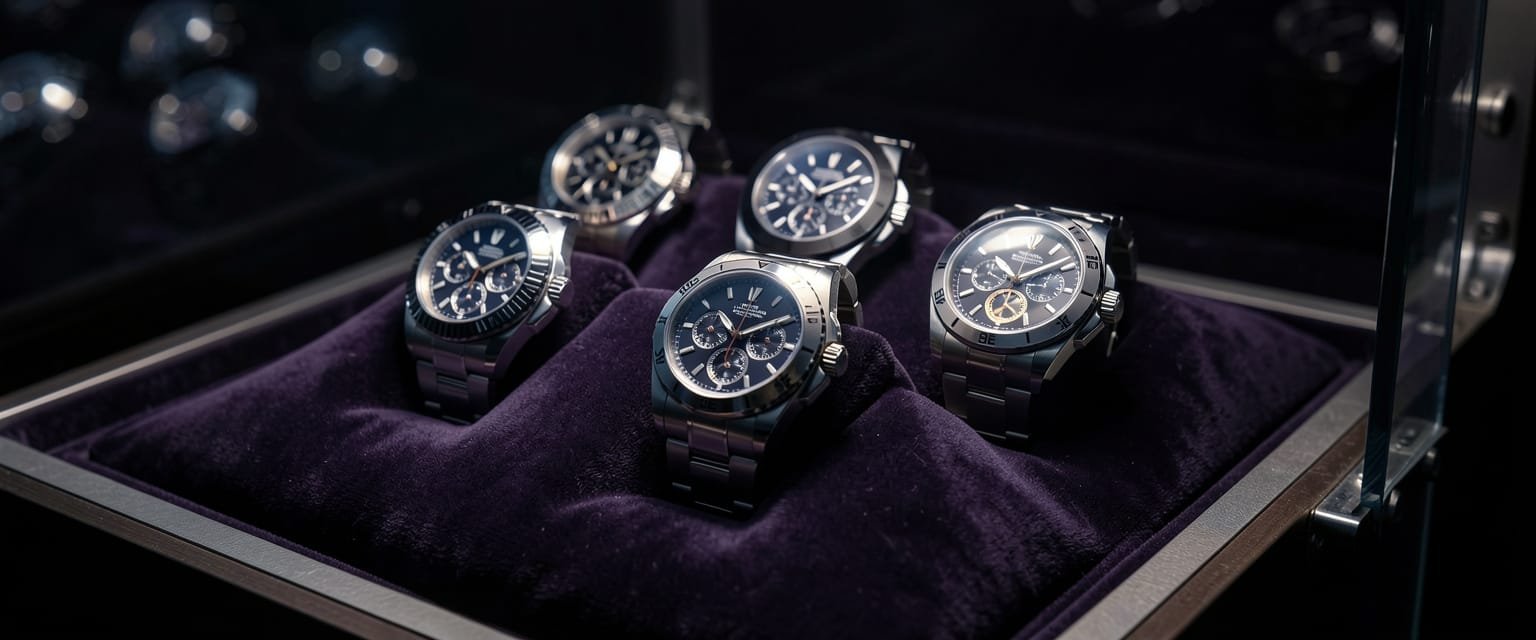
Credor Watches represent the highest expression of Japanese artisanal watchmaking, combining Spring Drive technology, ultra-thin mechanical movements, precious metals, hand-finished dials, and exceptional traditional craftsmanship.
Credor is a Japanese luxury watch brand founded by Seiko in 1974 as a collection of high-end watches made primarily from precious metals. Its name derives from the French expression crête d’or, meaning “crest” or “pinnacle of gold,” reflecting the brand’s original mission to create watches at the highest level of Japanese craftsmanship and aesthetic refinement. Over the following decades, Credor evolved far beyond precious-metal dress watches. It developed ultra-thin mechanical calibers, skeletonized movements, Spring Drive complications, hand-painted porcelain dials, artisanal engraving, and some of the most sophisticated watches ever created within the Seiko organization. In 2019, Credor became fully independent from the Seiko brand and was established as the company’s second luxury-watch pillar alongside Grand Seiko. Today the collection ranges from elegant Signo watches and ultra-thin Goldfeather models to the Gérald Genta-designed Locomotive, Spring Drive Kuon, and hand-finished Eichi II Masterpiece Collection. Credor’s finest watches are produced by elite Japanese craftsmen at facilities including the Micro Artist Studio and Shizukuishi Watch Studio.
Credor occupies a distinctive position within Japanese watchmaking. Grand Seiko is internationally recognized for precision, finishing, and modern manufacture watchmaking, while Credor moves further toward artistic expression, ultra-thin construction, precious materials, traditional Japanese crafts, and highly specialized handwork.
The brand originated in 1974, when Seiko grouped a selection of its finest precious-metal watches under the new Seiko Credor name. The word Credor derives from the French crête d’or, or “pinnacle of gold,” and the earliest collection was deliberately positioned at the highest end of Seiko’s watch portfolio.
Precious metals remain important to Credor today, but they no longer define the entire brand. Modern collections use platinum, 18K yellow, rose and white gold, high-intensity titanium, stainless steel, diamonds, mother of pearl, porcelain, urushi lacquer, and other traditional decorative materials.
Credor adopted its distinctive crest logo in 1980. The emblem was intended to symbolize the brand’s unlimited possibilities and remains one of its most recognizable visual identifiers.
One of Credor’s most important technical directions has always been ultra-thin mechanical watchmaking.
In 1993, the brand introduced watches powered by the ultra-thin Caliber 6870, part of a mechanical family whose architecture traces back to Seiko’s thin hand-wound movements of the 1960s. The current descendant, Caliber 6890, measures just 1.98mm thick and is assembled only by highly experienced watchmakers.
That movement forms the technical heart of the modern Goldfeather collection.
Goldfeather was revived as a Credor collection in 2023, drawing inspiration from the original Seiko Goldfeather concept of 1960. Its design philosophy is summarized as thin, light, smooth, elegant, and graceful — essentially attempting to give the watch the physical qualities of a feather.
Modern Goldfeather watches typically measure around 37mm, with extremely thin cases, sapphire crystals, hand-finished cases and lugs, and the manually wound Caliber 6890.
The regular GBBY972, for example, uses an 18K yellow-gold case, crocodile strap, box-shaped sapphire crystal, and Caliber 6890 with approximately 37 hours of power reserve. The complete watch is only about 7.7mm thick.
Credor uses the collection as a canvas for increasingly elaborate Japanese decorative crafts.
A 2026 Goldfeather limited edition uses an Imari Nabeshima porcelain dial created in collaboration with specialist artisans. The watch combines this traditional Japanese porcelain technique with the 1.98mm-thick Caliber 6890 and was announced at a European recommended retail price of €15,000.
Another 2026 Goldfeather uses urushi lacquer and taka maki-e in a platinum case. Limited to only 25 pieces, it was announced at €39,000.
At an even more ambitious level, Credor has produced Goldfeather tourbillons incorporating urushi lacquer and elaborate artisanal decoration, demonstrating how far the collection can extend beyond minimalist dress-watch design.
Another defining Credor technology is Spring Drive.
Spring Drive uses a conventional mainspring as its energy source but regulates the movement electronically rather than through a traditional mechanical escapement. The system provides the continuous glide of a mechanical gear train with quartz-controlled accuracy. Credor introduced its first Spring Drive watch in 1999.
Credor later used Spring Drive as the basis for extraordinary complications.
The Spring Drive Sonnerie appeared in 2006, followed by the Spring Drive Minute Repeater in 2011. These watches were major milestones in Japanese complicated watchmaking and demonstrated that Credor was operating well beyond the conventional luxury-dress-watch category.
The most famous modern expression of Credor Spring Drive is arguably the Eichi II.
The original Eichi debuted in 2008, while Eichi II followed in 2014. Its philosophy is deliberately restrained: rather than displaying complicated mechanisms on the dial, Credor attempts to reduce the watch to the purest possible expression of hours, minutes, and seconds.
Eichi II is manufactured by the Micro Artist Studio at Seiko Epson’s Shiojiri facility in Nagano Prefecture.
The studio was established in 2000 to preserve and develop exceptional watchmaking skills. Its craftsmen include recipients of major Japanese artisan awards and specialists capable of producing extremely complicated and highly finished watches.
The Eichi II’s porcelain dial is particularly famous.
Each of the twelve hour markers and the Credor logo are painted individually by hand by a craftsman. The movement is likewise assembled and decorated manually, including polished bridge edges, screw holes, jewel settings, and tempered blue screws.
Current Eichi II watches use the manually wound Spring Drive Caliber 7R14.
The movement incorporates Credor’s Torque Return System. When the mainspring produces more torque than necessary, some of that excess energy is redirected to rewind the spring rather than simply being lost. This extends the power reserve to approximately 60 hours.
Current Eichi II reference GBLT999 uses a Platinum 950 case, porcelain dial, sapphire crystal, crocodile strap, and Caliber 7R14. Its current Japanese retail price is ¥7,865,000.
Credor’s mechanical history also includes skeleton watches.
The Caliber 6899, introduced in skeleton watches during the 1990s, uses movement architecture inspired visually by bamboo swaying in the wind. The movement includes a special torque-control system designed to help stabilize the balance despite the open construction.
The brand’s Art Piece Collection has continued this tradition through hand engraving, relief decoration, skeletonization, and highly specialized artisan techniques.
Credor also holds a special place in the history of watch design because of its connection with Gérald Genta.
Genta, responsible for some of the most famous watch designs of the twentieth century, developed the original Credor Locomotive in 1979. Its integrated bracelet, angular geometry, and exposed bezel screws reflected the bold luxury-sports-watch language for which Genta became famous.
For Credor’s 50th anniversary in 2024, the Locomotive was revived.
The new version remained faithful to Genta’s original drawings while updating the engineering and finishing. Its case, bezel, crown, bracelet links, and screws repeatedly use a distinctive hexagonal motif.
The current Locomotive is powered by the Credor-exclusive CR01 automatic movement.
Despite being self-winding, the movement is less than 4mm thick, allowing the entire watch to remain below 9mm. Current reference GCCR995 measures 38.8mm in diameter and 8.9mm thick.
The case and bracelet are produced from High-Intensity Titanium, approximately 30% lighter than stainless steel while providing greater scratch resistance. Sapphire crystal, 100-meter water resistance, a screw-down crown, and approximately 45 hours of power reserve make the Locomotive one of Credor’s most practical contemporary watches.
The Kuon collection represents another contemporary direction.
The name comes from a Japanese word expressing an endless flow of time from the distant past into the future. The watches combine flowing case surfaces, porcelain dials, heat-treated hands, and an understated elegance intended to remain visually timeless.
Kuon uses the Credor-exclusive Caliber 7R31, a manually wound Spring Drive movement with approximately 72 hours of power reserve — one of the longest reserves offered by a dedicated Credor movement.
Importantly, the power-reserve display is moved to the rear of the watch, preserving the uncluttered porcelain dial.
At the more jewelry-oriented side of the catalog is Signo.
Signo includes elegant men’s and women’s pieces powered by quartz, mechanical, automatic, and Spring Drive movements. Current versions use precious metals, diamonds, mother of pearl, titanium, and stainless steel.
Some of the most accessible current Credor watches actually come from this collection.
Current Japanese pricing for selected Signo quartz watches begins around ¥781,000–¥913,000, although models using precious metals and heavier jewelry decoration can cost substantially more.
This makes Credor’s price structure unusually broad.
The least expensive current pieces cost roughly several thousand U.S. dollars, while high-complication, precious-metal, tourbillon, and artisan limited editions can enter the six-figure-dollar range.
That price spread explains why Credor is difficult to compare with one conventional competitor.
At the lower end, it overlaps with high-end Grand Seiko. At the upper end, its craftsmanship, limited production, precious materials, and complications place it alongside prestigious independent and traditional European haute horlogerie houses.
The difference between Credor and Grand Seiko is especially important.
Both belong to Seiko Watch Corporation, but they are now distinct luxury brands.
Grand Seiko emphasizes precision, legibility, Japanese nature-inspired design, advanced manufacture calibers, and highly consistent technical finishing.
Credor places greater emphasis on artisanal expression, thinness, precious materials, jewelry watchmaking, handcrafted decoration, traditional Japanese crafts, and highly specialized low-volume production.
In 2019, Seiko formally made Credor independent from the Seiko brand, describing it as the company’s second pillar of luxury watches alongside Grand Seiko.
The separation has become even more visible recently.
Credor celebrated its 50th anniversary in 2024, revived the Locomotive, expanded Goldfeather, and announced its first participation in Watches and Wonders Geneva in 2026, placing the brand on one of the international luxury-watch industry’s most important stages.
Credor therefore should not be viewed simply as “expensive Seiko.”
It represents a distinct philosophy within Japanese luxury watchmaking: sophisticated technology deliberately combined with the handwork of individual artisans.
A Credor may contain an innovative Spring Drive movement, but the dial may simultaneously require a craftsman to paint every marker by hand.
An ultra-thin mechanical movement may use modern precision manufacturing, yet its assembly can be sufficiently demanding that only an experienced specialist is permitted to build it.
A watch may be technically simple with only three hands but require porcelain firing, hand polishing, blueing, engraving, and weeks of artisanal work.
That philosophy is summarized by Credor today as “The Creativity of Artisans.”
Positioned within the High Luxury segment, Credor Watches are particularly relevant for collectors seeking something beyond conventional Swiss prestige: Japanese haute horlogerie, Spring Drive technology, extreme mechanical thinness, hand-painted porcelain, urushi lacquer, Gerald Genta design history, precious-metal craftsmanship, and watches produced in quantities small enough to preserve a genuine artisanal character.
Price Range: $5,000 – $200,000+
Positioning: High Luxury
Choose a country to explore trusted online stores and authorized retailers where Credor Watches may be available.
Yes. Credor is one of Japan’s most prestigious high-end watch brands and represents the artisanal luxury side of Seiko Watch Corporation. Its watches include proprietary mechanical and Spring Drive movements, hand-painted porcelain dials, precious-metal cases, traditional Japanese decorative techniques, and highly specialized hand finishing.
Credor was originally launched by Seiko in 1974 as Seiko Credor, but its modern status is more distinct. In 2019, Credor became independent from the Seiko brand and was established as a separate luxury-watch pillar of Seiko Watch Corporation alongside Grand Seiko.
Credor was founded in 1974. The original collection grouped Seiko’s high-end watches made from precious metals under the new Credor name, derived from the French crête d’or, meaning “pinnacle of gold.”
Credor watches are made in Japan. Different collections involve specialized Japanese facilities, including the Micro Artist Studio at Seiko Epson’s Shiojiri facility and the Shizukuishi Watch Studio, where ultra-thin mechanical movements such as Caliber 6890 are produced.
Both are independent luxury brands within Seiko Watch Corporation, but their emphasis differs. Grand Seiko focuses heavily on precision, manufacture movements, technical performance, and a recognizable Japanese design language. Credor places greater emphasis on high artisanal craftsmanship, precious materials, ultra-thin construction, jewelry watchmaking, hand-painted and traditionally crafted dials, and extremely limited high-horology production.
The Eichi II is one of Credor’s signature Masterpiece watches. It is produced by the Micro Artist Studio and combines a manually wound Spring Drive Caliber 7R14 with a porcelain dial whose hour markers and Credor logo are individually painted by hand. The movement offers approximately 60 hours of power reserve through its Torque Return System.
Goldfeather is Credor’s ultra-thin mechanical dress-watch collection. Modern versions use the manually wound Caliber 6890, which measures only 1.98mm thick. The collection includes precious-metal watches and special editions featuring Japanese crafts such as urushi lacquer and Imari Nabeshima porcelain.
The original Credor Locomotive was designed by Gérald Genta and introduced in 1979. Credor revived the model for its 50th anniversary in 2024, preserving Genta’s hexagonal integrated-bracelet design while updating it with modern materials and manufacturing.
Yes. Spring Drive has been part of Credor since 1999. Current watches such as the Eichi II and Kuon use manually wound Spring Drive calibers specifically developed for Credor. Kuon’s Caliber 7R31 offers approximately 72 hours of power reserve, while Eichi II uses the hand-finished Caliber 7R14.
Credor prices reflect low-volume Japanese production, extensive hand finishing, precious metals, complex proprietary movements, and specialized artisan techniques. Depending on the model, a Credor may require hand-painted porcelain, urushi lacquer, maki-e, engraving, platinum or gold cases, ultra-thin mechanical movements assembled by master watchmakers, or production at the elite Micro Artist Studio. Credor’s most complicated and limited watches therefore compete with international haute horlogerie rather than conventional mass-produced watches.