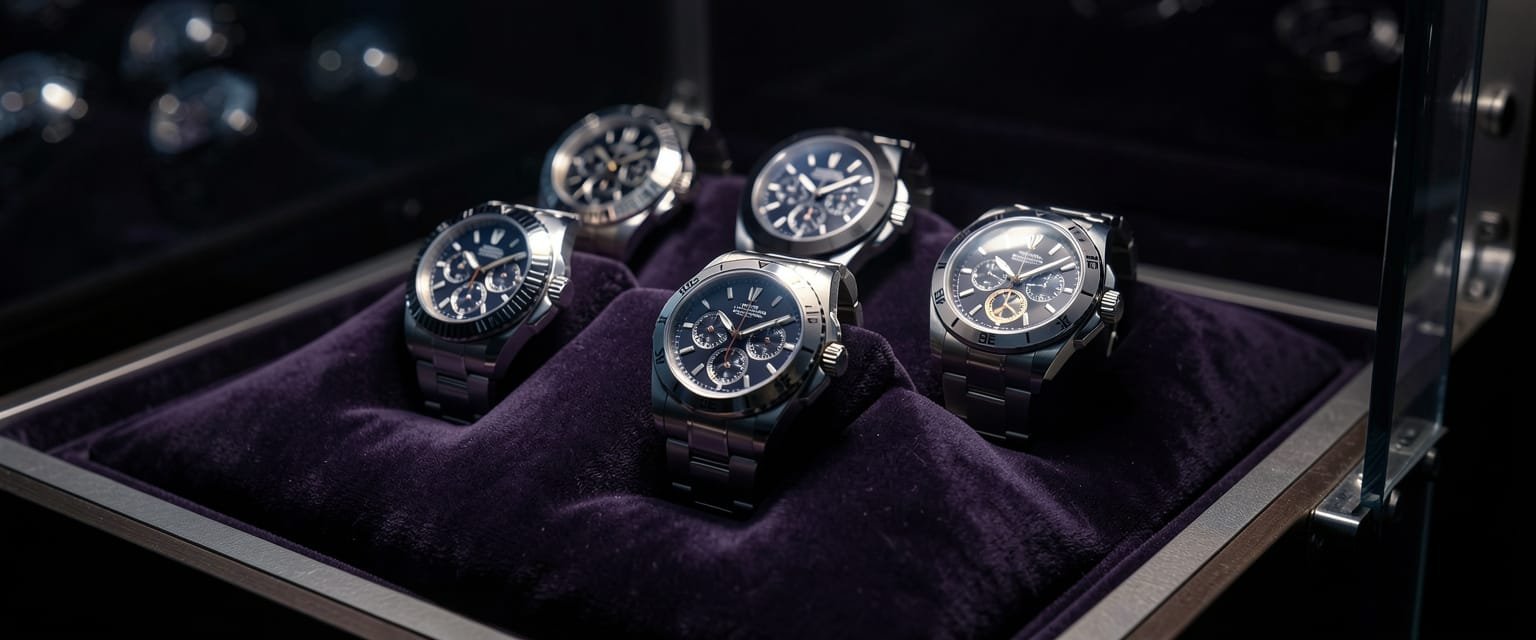

Breda Watches blend Dallas design culture with vintage-inspired shapes, Japanese quartz movements, jewelry-like bracelets, mother-of-pearl dials, and unconventional wearable timepieces such as Time Rings.
BREDA is an independent American watch brand founded in Dallas, Texas, in 2009 by siblings Amir and Shabeena Meghani. The company grew from their family’s multigenerational involvement in the watch business and was originally created as the second in-house brand of what was then known as Grand Time, today the independent timepiece company MEGHANI. While BREDA originally competed more directly in the affordable fashion-watch market, its identity has evolved considerably. The current brand focuses on compact vintage-inspired silhouettes, jewelry-like bracelets, sculptural cases, unusual ways of wearing time, and a deliberately genderless approach to design. BREDA describes time as its “medium, mentor and muse” and places individuality and self-expression at the center of the collection. Current collections include Jane, Pulse, Esther, Revel, Virgil, Coda, Sync, Groove, Play, Nocturne, and multiple Tethered and Revival variations. The catalog has also expanded beyond conventional wristwatches with Time Rings and Time Chokers, reinforcing BREDA’s position somewhere between watch design and contemporary jewelry.
BREDA has changed substantially since its beginnings in 2009. What started as an affordable fashion-watch label from a family already established in the watch trade has developed into a much more distinctive design brand built around small-scale watches, jewelry-inspired forms, unconventional proportions, and the idea of timepieces as objects of personal expression.
The company belongs to the Meghani family’s broader watch business. The family history dates to the mid-twentieth century, when Abdul Meghani began selling watch bands in India and later dealt in Swiss watches. His son Akber Meghani eventually moved to Dallas and established Grand Time, while the third generation — siblings Amir and Shabeena Meghani — joined the company in the mid-2000s and began moving it from distribution toward developing proprietary brands. BREDA followed in 2009.
Contemporary reporting from Dallas confirms that Amir and Shabeena founded BREDA together and developed the business from the family’s existing watch operation. By the middle of the 2010s, the company had established its own design studio in Dallas’ Deep Ellum neighborhood, with product design, sourcing decisions, prototyping, and creative development handled locally.
That Dallas connection remains important today. BREDA Studio is currently located on Taylor Street in Dallas, and the brand frequently ties its projects to the city’s creative, fashion, art, and sporting communities. The company has collaborated locally and has served as Official Time Partner of Dallas Trinity FC.
BREDA’s design philosophy has moved away from the conventional idea that watches need to be separated rigidly into men’s and women’s categories. The company explicitly describes its approach as genderless, creating watches intended to work as objects of adornment and self-expression rather than products tied to traditional gender-based watch conventions.
This philosophy is visible in the dimensions of the modern catalog. BREDA frequently uses cases far smaller than those found in contemporary mainstream watches. Current references include 18mm, 20mm, 23mm, and 26mm cases, along with similarly compact rectangular and square forms.
The Jane has become one of the brand’s most recognizable designs. Its oval case and jewelry bracelet deliberately evoke vintage dress watches rather than modern sports watches. Current Jane models use a delicate 23mm case, while Jane Tethered Small references reduce that silhouette to only 18mm.
Natural mother-of-pearl dials are especially important within the Jane family. Because mother of pearl is an organic material, color and texture naturally vary between individual watches, giving otherwise standardized production pieces slightly different appearances.
The Tethered versions replace a conventional link bracelet with tapered woven-metal mesh. BREDA introduced the Tethered concept in 2022 around the idea of objects becoming connected with memories and relationships, and later expanded it with even smaller Jane and Virgil silhouettes.
The Virgil takes a more architectural approach with a narrow rectangular case. Current models use approximately 26mm cases and are available with leather straps or tapered metal bracelets. Gold versions use 18K gold plating over the case rather than solid gold, while silver versions use stainless steel.
That distinction is useful for buyers because BREDA’s visual presentation can resemble fine jewelry, but the materials and pricing place the watches firmly within the accessible design segment. Gold-colored cases and bracelets are plated stainless steel rather than solid precious metal.
The Esther uses a squarer 26mm case with a slightly stronger wrist presence while preserving the minimal styling of the broader collection. Current models combine stainless-steel or 18K gold-plated cases with metal bracelets and Japanese Miyota quartz movements.
Another important family is Revel. It uses an unusually petite 18mm square case with a jewelry-clasp bracelet, making the watch closer in scale and appearance to a bracelet accessory than a conventional contemporary wristwatch. Current Revel references use Japanese Seiko quartz movements and 3 ATM splash resistance.
The Pulse collection emphasizes a slim rectangular profile and minimal display. Current models use approximately 26mm cases and tapered bracelets, while the newer Pulse Tandem expands the idea with multi-element designs priced at the upper end of BREDA’s conventional wristwatch range.
BREDA’s experimentation with scale and placement has gone beyond wristwatches entirely. One of its most distinctive modern products is the Time Ring, a functional analog watch designed to be worn on a finger.
The original collaborative BREDA × DALMATA Time Ring uses a tiny 15mm square stainless-steel case integrated into an expandable ring band. Variants are available in stainless steel or 18K gold-plated stainless steel and feature 24 Austrian crystals around the bezel. Inside is a Japanese-made Miyota quartz movement.
BREDA followed this idea with the Nocturne Time Ring, which uses a 16mm rectangular case and colored crystal covering. Depending on the reference, these pieces use Japanese Seiko or Miyota quartz movements and retain the same 3 ATM splash-resistant specification as many of the brand’s wristwatches.
Time Rings demonstrate particularly clearly how BREDA differs from a conventional affordable watch company. The objective is not to maximize dial visibility, water resistance, complications, or movement specifications. Instead, timekeeping is integrated into an object that functions primarily as jewelry.
BREDA has extended the same idea to Time Chokers, including Groove and Sync designs. These place a time display within a jewelry piece worn around the neck, further blurring the traditional distinction between watches and accessories. Current Time Chokers are priced around $245.
Mechanical horology is not the focus of the current BREDA collection. The brand’s main contemporary watches use Japanese quartz movements, particularly calibers supplied by Miyota and Seiko.
For example, the Jane, Esther, Virgil, and Pulse families commonly use Japanese-made Miyota quartz movements, while selected newer compact watches such as Jane Tethered Small and Revel use Japanese-made Seiko quartz movements.
This movement strategy fits BREDA’s purpose. Quartz movements allow thin cases, minimal maintenance, small case dimensions, and comparatively low prices. A thick automatic caliber would make many of the company’s miniature 18–23mm jewelry-watch designs substantially more difficult to execute.
Materials likewise prioritize appearance and everyday wear over professional sports-watch specifications. Stainless steel is common across the collection, while gold models generally use 18K gold plating over stainless steel. Genuine leather appears on selected Virgil models, and woven stainless-steel mesh is central to the Tethered collection.
Mother of pearl provides a more premium decorative element in selected Jane references, while the DALMATA Time Ring uses Austrian crystals. Colored crystals are also used as visual elements in the Nocturne Time Ring.
Water resistance is intentionally modest. Many current products are rated to 3 ATM / 30 meters, and BREDA describes them as splash resistant rather than watches intended for immersion. They can tolerate situations such as rain or hand washing, but the company explicitly advises that its watches should not be submerged.
This makes BREDA very different from sports-oriented brands such as Seiko or Citizen. Buyers should view the watches as design and jewelry accessories rather than swimming, diving, or outdoor-performance watches.
The company currently provides a two-year warranty covering manufacturer defects in the watch movement. Normal wear and tear is excluded, and BREDA operates a repair process for watches requiring movement service.
Pricing has moved upward considerably from BREDA’s earliest years, when the company became known for inexpensive fashion watches. Current mainstream styles generally fall between approximately $150 and $250, with Esther around $150, Virgil around $150–$185, Jane and Pulse around $195, Coda around $215, and Pulse Tandem models reaching approximately $230–$250. Archive pieces and sale watches can occasionally fall below $100.
The current catalog therefore competes less on absolute low price than the original BREDA did. Its appeal today comes increasingly from recognizable design, unusually petite dimensions, jewelry construction, and a visual identity that is difficult to confuse with conventional department-store fashion watches.
Collaborations form another important part of that identity. The DALMATA Time Ring is a particularly visible example because it resulted in an entirely different format for wearing a timepiece rather than simply applying another company’s logo to an existing watch.
BREDA also uses editorial projects and creative collaborations to connect watches with art, fashion, photography, and the Dallas community. This reflects the brand’s broader positioning as part watch company and part creative design studio.
The company’s parent business, MEGHANI, remains independent and family-run. Amir and Shabeena Meghani now lead the wider organization, whose two in-house timepiece brands are BREDA and JBW. The relationship is useful for understanding BREDA: although the brand appears young and fashion-focused, it emerged from several generations of professional involvement in watch retailing and distribution.
BREDA should nevertheless not be evaluated as a traditional manufacture. There are no proprietary mechanical calibers, advanced complications, high water-resistance sports watches, or emphasis on traditional hand-finishing. Its expertise lies primarily in design and the reinterpretation of affordable quartz timekeeping as wearable visual objects.
Compared with brands such as Fossil, BREDA has a substantially narrower catalog and places greater emphasis on compact unconventional shapes and artistic presentation. Compared with minimalist brands such as Daniel Wellington or CLUSE, its watches generally show more experimentation with case geometry, natural dials, bracelet architecture, and unusual formats.
The renewed popularity of small vintage watches also works strongly in BREDA’s favor. While much of the watch industry spent decades increasing case diameters, BREDA currently offers numerous pieces below 30mm and some as small as 18mm, making the collection particularly relevant to the contemporary return of petite watches and jewelry watches.
This does not necessarily mean those watches are exclusively intended for women. BREDA explicitly takes a genderless approach and encourages customers to select according to personal style rather than traditional watch sizing rules.
For buyers, the strongest reasons to choose BREDA are therefore design, scale, individuality, and jewelry-like wearability. The brand offers something visually different from both conventional fashion watches and technical enthusiast watches without moving beyond an accessible price level.
Positioned within the Entry Level design-watch segment, Breda Watches are especially relevant for buyers seeking petite vintage-inspired watches, rectangular and oval cases, mother-of-pearl dials, sculptural bracelets, Japanese quartz reliability, and unusual timepiece formats such as finger-worn Time Rings.
Price Range: $95 – $250+
Positioning: Entry Level
Yes, particularly for buyers who prioritize design over mechanical complexity. BREDA offers distinctive vintage-inspired and jewelry-like watches with stainless-steel construction, Japanese quartz movements, mother-of-pearl dials on selected models, and unusually compact case sizes at accessible prices.
Yes. BREDA is an American brand founded in Dallas, Texas, and the company continues to operate its design studio in Dallas. Its watches use internationally sourced components, including Japanese Miyota and Seiko quartz movements.
BREDA was founded in 2009. It developed from the Meghani family watch business and became the second proprietary watch brand created by Amir and Shabeena Meghani after they began moving the family company toward in-house brand development.
BREDA was founded by siblings Amir and Shabeena Meghani, third-generation members of a family involved in the watch business. They launched BREDA from their family company in Dallas and continue to lead parent company MEGHANI.
BREDA is designed and based in Dallas, but the official site does not identify one universal final manufacturing country for the entire collection. Current product specifications show extensive use of Japanese-made Miyota and Seiko quartz movements, so buyers should use the individual model specifications rather than assuming the watches are manufactured entirely in the United States.
Current BREDA collections primarily use Japanese quartz movements from Miyota and Seiko. Jane, Esther, Virgil, Pulse, and several Time Ring models use Miyota quartz calibers, while selected Revel, Jane Tethered Small, and Nocturne models use Seiko quartz movements.
Major current collections include Jane, Pulse, Esther, Revel, Virgil, Coda, Sync, Groove, Play, and Nocturne, together with Tethered and Revival variations. Jane, Pulse, and Esther are prominently featured among BREDA’s current best-selling designs.
A BREDA Time Ring is a miniature functional analog watch designed to be worn on a finger instead of the wrist. Current examples include the BREDA × DALMATA and Nocturne Time Rings, with approximately 15–16mm cases, expandable bands, and Japanese quartz movements.
No. BREDA describes its watches as water resistant rather than waterproof. Many current models are rated to 3 ATM and are intended to tolerate splashes, rain, and normal hand washing, but the company advises against submerging them in water.
BREDA distinguishes itself through unusually small vintage-inspired cases, oval and rectangular shapes, mother-of-pearl dials, sculptural bracelets, a genderless design philosophy, and experimental formats such as Time Rings and Time Chokers. Its current identity places timekeeping closer to jewelry and contemporary product design than to conventional sports or mechanical watchmaking.