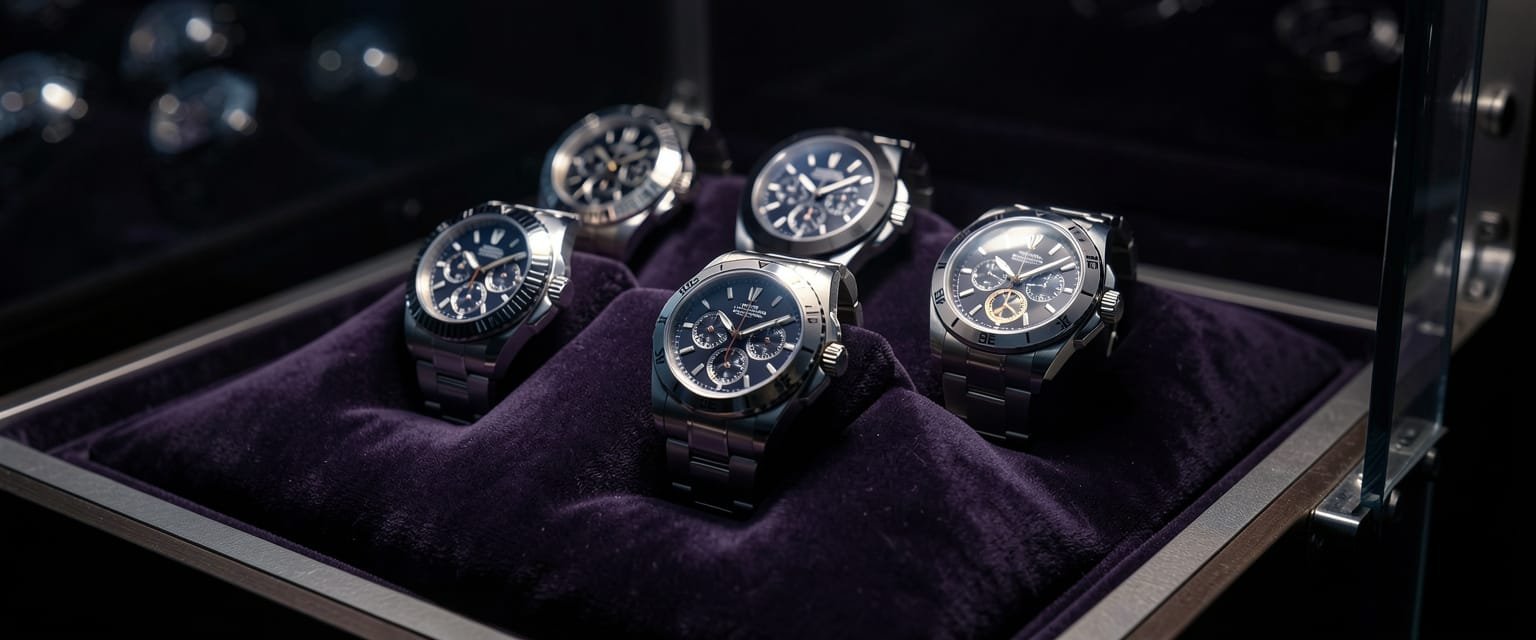

Bering Watches combine minimalist Danish design with Arctic-inspired colors, scratch-resistant sapphire crystal, titanium, high-tech ceramic, solar technology, and reliable automatic and quartz movements.
Bering is a Danish watch and jewelry brand launched in September 2010 by Michael Witt Johansen, René Gross Kaerskov, and Lars Gram-Skjønnemann. The concept grew from the founders’ fascination with the Arctic and an ambition to translate its clear landscapes, cool colors, and apparent simplicity into contemporary Danish watch design. The brand takes its name from Vitus Bering, the Danish explorer whose name also survives in the Bering Strait. Today, Bering is headquartered in Aabenraa, Denmark, and its watches are distributed internationally through thousands of retailers as well as the company’s regional online stores. Bering’s current watch catalog includes Classic, Ceramic, Solar, Titanium, Automatic, Ultra Slim, Max René, Pebble, True Aurora, and additional specialty designs. Across the range, the company emphasizes clean Scandinavian styling, thin cases, sapphire crystal, stainless steel, titanium, and high-tech ceramic.
Bering occupies an interesting middle ground between fashion watches and traditional enthusiast watch brands. Its designs are intentionally simple and style-driven, but the company frequently uses materials such as sapphire crystal, titanium, and high-tech ceramic that are less common among inexpensive fashion watches.
The company was established in 2010 after Danish adventurer and businessman René Gross Kaerskov’s Arctic experiences helped inspire the idea for a new watch brand. Kaerskov had parachuted over the North Pole, while co-founder Michael Witt Johansen had developed his own fascination with Greenland and the wider Arctic from childhood. Together with Lars Gram-Skjønnemann, they launched Bering in September 2010.
The founders deliberately connected the new company with the tradition of Danish industrial design. Rather than complicated dials or heavily decorated cases, Bering generally favors straightforward geometric forms, restrained hour markers, slim hands, uncluttered dials, and carefully controlled use of color.
This visual language is paired with the company’s “Inspired by Arctic Beauty” identity. White, ice blue, deep navy, grey, black, silver, and cool metallic finishes appear frequently throughout the catalog, although newer watches also introduce brighter greens, oranges, gold tones, and other contemporary colors.
One of the strongest practical features across Bering’s modern watch collection is sapphire crystal. The company describes its watches as using hard, scratch-resistant sapphire glass throughout the range, including comparatively inexpensive quartz models. This provides a useful advantage over many similarly priced fashion watches that continue to rely primarily on mineral crystal.
The Classic Collection represents the simplest expression of Bering’s design philosophy. These watches are generally quartz-powered and concentrate on slim proportions, clean dials, stainless-steel cases, and Milanese mesh, leather, or link bracelets.
Current U.S. Classic watches generally retail in approximately the $120–$290 range depending on size, finish, bracelet, and model. A number of designs use extremely thin cases, making them particularly suitable for buyers who want a lightweight everyday or business watch rather than a substantial sports watch.
The Ultra Slim collection pushes this approach further, concentrating on reduced case thickness and minimal visual complexity. These models demonstrate one of the advantages of quartz technology: a watch can remain extremely thin while still providing dependable everyday timekeeping.
Bering’s Ceramic Collection adds one of the brand’s most recognizable materials. Rather than making an entire watch case from ceramic in every instance, many references combine stainless steel with polished high-tech ceramic bezels or ceramic bracelet links.
The company highlights several advantages of this material: high scratch resistance, low weight, resistance to heat, a hypoallergenic nature, and a smooth tactile finish. Current ceramic watches frequently pair the material with sapphire crystal and quartz movements.
Ceramic also allows Bering to use glossy black, white, blue, and other color treatments that would be difficult to achieve with untreated stainless steel alone. Women’s models in particular often combine ceramic with polished gold-tone or rose-gold-tone steel to create a more jewelry-oriented appearance.
The Titanium Collection serves buyers who value low weight and comfort. Bering uses titanium for both cases and bracelets on selected watches, producing pieces that can feel noticeably lighter than equivalent stainless-steel models.
A current 40mm titanium reference combines a titanium case, titanium bracelet, sapphire crystal, quartz movement, date display, and 10 ATM water resistance. Other titanium models provide 5 ATM, so exact water resistance should always be checked for the individual reference.
Solar watches form another major part of Bering’s identity. The Solar Collection converts both sunlight and artificial light into electrical energy stored in a rechargeable secondary battery.
According to Bering, a fully charged solar watch can continue operating for approximately six to twelve months in complete darkness, depending on the model. This eliminates the need for frequent conventional battery replacement while retaining the accuracy and simplicity of quartz timekeeping.
Solar technology appears in both men’s and women’s watches and is combined with stainless steel, titanium, and even high-tech ceramic. A current women’s ceramic solar model integrates ceramic bracelet links and dial elements with sapphire crystal, while men’s titanium solar models combine light-powered movements with lightweight cases and up to 10 ATM water resistance.
The brand also produces automatic mechanical watches for buyers who prefer traditional movement technology. Bering currently uses automatic calibers supplied by Seiko or Miyota, two established Japanese movement manufacturers.
Current Bering automatics can provide up to approximately 42 hours of power reserve and typically include transparent case backs that allow the movement to be viewed. Some models also use open-heart dial designs that expose part of the balance mechanism from the front.
One interesting historical example is the Bering VITUS 1728 automatic project, developed in cooperation with Miyota. More recent automatic models continue to combine Japanese mechanics with the company’s distinctly Scandinavian exterior design.
Current U.S. automatic watches generally occupy the upper end of the Bering catalog. Standard models are listed around $299, while newer automatic references can reach approximately $349.
Bering also offers radio-controlled watches in selected markets. These models synchronize with a radio time signal where compatible service is available, allowing the watch to correct its time automatically. A current 40mm radio-controlled model combines this functionality with stainless steel, Milanese mesh, sapphire crystal, a digital date display, and 5 ATM water resistance.
The Max René Collection adds a more explicitly design-driven element to the catalog. Developed around the work of Danish designer Max René, it uses an interchangeable strap system that allows the wearer to slide straps in and out quickly without conventional spring-bar tools.
This gives a single watch several different visual identities simply by changing strap color or material. The concept fits Bering’s broader Scandinavian approach: mechanical complexity is minimized, while functionality is incorporated into a clean physical design.
Other ranges such as Pebble and True Aurora give the brand more freedom with case shapes and colors while maintaining the same minimalist foundation. Bering also sells watch-and-jewelry sets, reflecting its parallel jewelry business.
The breadth of case sizes is particularly useful. Women’s models can be very compact, including petite watches below 30mm, while men’s models commonly sit around 39–43mm. This means Bering is not locked into the oversized-watch aesthetic that characterizes many fashion brands.
Materials vary by model but commonly include 316L stainless steel, titanium, high-tech ceramic, sapphire crystal, calfskin leather, silicone, Milanese stainless-steel mesh, and conventional metal link bracelets.
Water resistance is more lifestyle-oriented than dive-oriented. Elegant ceramic watches may provide 3 ATM, many everyday titanium and Classic models use 5 ATM, and selected titanium or solar watches reach 10 ATM. Bering is therefore better viewed as an everyday design watch brand than as a specialist diving-watch manufacturer.
Bering provides an international three-year warranty on its watches. This is longer than the two-year warranty commonly offered by many watch brands in the same general segment. Normal wear, batteries, straps, crystals, crowns, accidental damage, and unauthorized servicing are subject to the exclusions in the warranty conditions.
Pricing is relatively consistent across the modern range. Current full-price U.S. watches begin around $119–$129 for entry-level Classic and Titanium references. Many Classic, Ceramic, and Solar watches sit between approximately $170 and $290, while current automatic models reach around $299–$349. Promotional sale pricing can be considerably lower.
This pricing is one reason Bering competes successfully with both fashion brands and established affordable watch companies. Buyers receive a recognizable Danish design language together with sapphire crystal and materials such as titanium or ceramic without moving into luxury-watch pricing.
Bering’s approach differs from traditional mechanical brands such as Tissot or Junghans. The company does not emphasize manufacture movements, complicated watchmaking, or a century-long horological history. Its expertise lies instead in product design, materials, accessible technology, and cohesive branding.
Compared with minimalist fashion brands, however, Bering generally provides stronger watch-specific specifications. Sapphire crystal across the range, solar movements, titanium cases, high-tech ceramic, Japanese automatics, and a three-year warranty give its watches more substance than designs built primarily around appearance.
The brand has also grown rapidly since its launch. Founder Michael Witt Johansen states that Bering had more than 1,000 retail locations after its first year and later expanded globally, with the company now citing more than 7,500 specialist retailers worldwide.
Positioned within the mid-range design-watch segment, Bering Watches are particularly suitable for buyers looking for clean Scandinavian styling, thin everyday watches, scratch-resistant sapphire crystal, lightweight titanium, ceramic construction, solar technology, or accessible automatic watches without the price of traditional Swiss luxury brands.
Price Range: $100 – $350+
Positioning: Mid-Range
Choose a country to explore trusted online stores and authorized retailers where Bering Watches may be available.
Yes. Bering is a well-established Danish design-watch brand offering strong specifications for its price range. Its watches commonly include sapphire crystal, stainless steel, titanium or high-tech ceramic, with quartz, solar, and Japanese automatic movements available across the catalog.
Yes. Bering was created by three Danish founders and is headquartered in Aabenraa, Denmark. Its watches are strongly influenced by Scandinavian minimalism and the colors and landscapes of the Arctic.
Bering was launched in September 2010 by Michael Witt Johansen, René Gross Kaerskov, and Lars Gram-Skjønnemann. The concept was inspired partly by Kaerskov’s Arctic expedition and the founders’ shared interest in Danish design.
The name refers to Vitus Bering, the Danish explorer associated with exploration of the Arctic region and the Bering Strait. The Arctic connection also reflects the landscapes that inspired the brand’s design identity.
Yes. Bering states that its watches use scratch-resistant sapphire crystal, including many relatively affordable quartz, solar, titanium, ceramic, and automatic models.
es. Bering offers mechanical automatic watches using Seiko and Miyota movements. Current models can provide up to approximately 42 hours of power reserve and often include exhibition case backs or open-heart displays.
Bering solar watches convert sunlight or artificial light into electricity and store it in a rechargeable battery. Once fully charged, selected models can continue running for approximately six to twelve months in complete darkness.
Yes, although water resistance varies considerably by model. Some slim Ceramic watches provide 3 ATM, many everyday models offer 5 ATM, and selected Titanium and Solar watches reach 10 ATM. Buyers should check the exact specification before swimming or using a watch around water.
Both brands are strongly associated with minimalist Danish-inspired watch design and slim everyday watches. Bering places particularly strong emphasis on sapphire crystal, titanium, high-tech ceramic, and solar technology, while also maintaining a current automatic collection using Seiko and Miyota mechanical movements.
Bering combines its Arctic-inspired Scandinavian aesthetic with unusually practical materials for the price. Sapphire crystal is used throughout the watch range, while buyers can choose among titanium, high-tech ceramic, solar movements, radio-controlled technology, quartz, and Japanese automatics rather than being limited to simple fashion-oriented quartz watches.