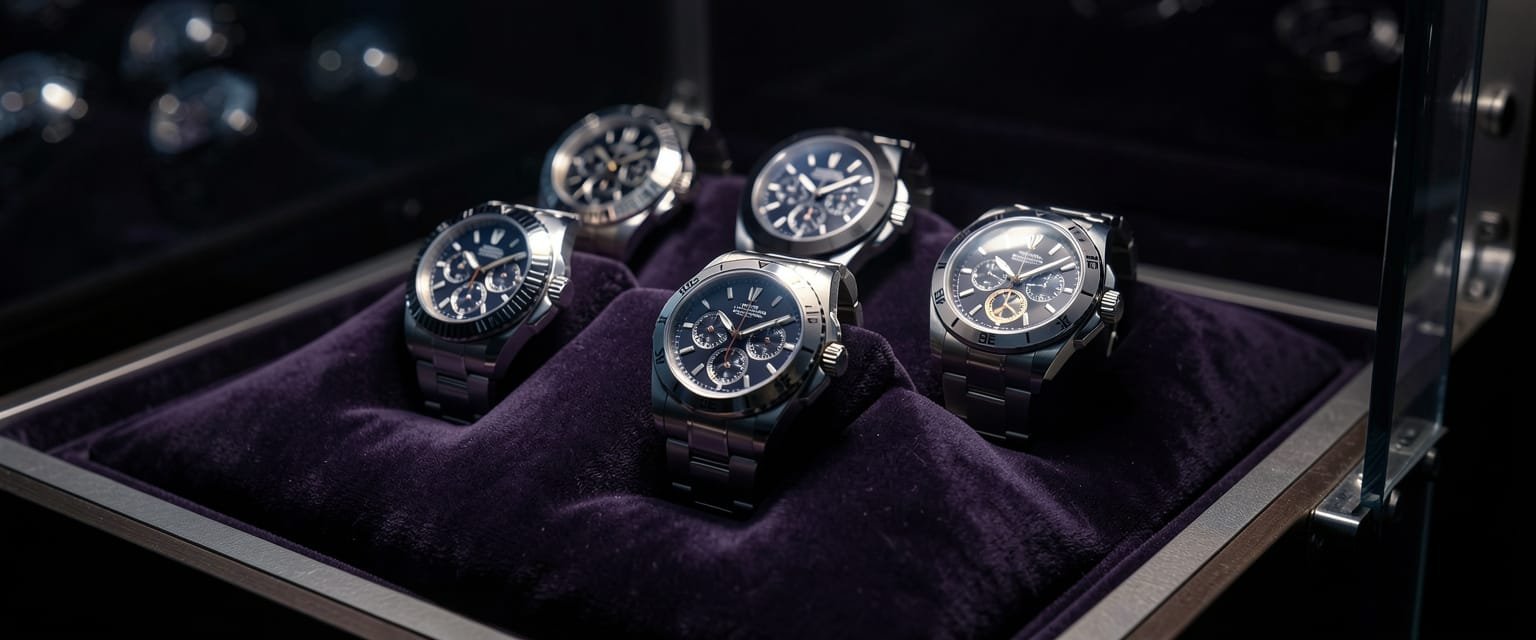

Epos Watches combine independent Swiss mechanical watchmaking with decorated ETA and Sellita movements, distinctive complications, skeleton designs, moon phases, GMT watches, and professional 500-meter divers.
Epos is an independent Swiss mechanical watch company founded in 1983 by watch industry specialist Peter Hofer. Its technical heritage reaches further back to the work of James Aubert, who established a movement workshop in Switzerland's Vallée de Joux in 1925 and became known for complicated mechanical mechanisms. Hofer built Epos during the quartz crisis around an unusual conviction for the early 1980s: traditional mechanical watches still had a future. Working closely with watchmaker Jean Fillon, who inherited the technical knowledge of the Aubert workshop, Epos developed a reputation for modifying and decorating established Swiss movements rather than simply using them in standard form. Today Epos Uhren AG is based in Lengnau, Switzerland, and remains focused primarily on Swiss Made mechanical watches. Current collections range from classic automatic and moon-phase models to skeleton watches, the unusual Verso series, GMT complications, 500-meter divers, and the rare five-minute repeater.
Epos is an independent Swiss watch company specializing in mechanical watches with unusual complications, movement modifications, and visible mechanical architecture.
The modern Epos brand was founded in 1983 by Peter Hofer, an experienced specialist in the Swiss watch industry who continued to believe in mechanical watchmaking during the quartz crisis.
The company’s technical roots, however, extend back much further.
In 1925, watchmaker James Aubert established a workshop in the Vallée de Joux, one of the historic centers of complicated Swiss watchmaking. Aubert devoted much of his career to mechanical mechanisms, including chronographs and repeating watches.
His expertise was passed to his son-in-law Jean Fillon, who later became an important technical partner of Peter Hofer and contributed to many of the movement modifications associated with Epos.
This distinction explains why Epos can legitimately refer to watchmaking traditions reaching back to 1925 while the Epos company itself dates from 1983.
Hofer founded Montres EPOS SA at a time when much of the Swiss industry was abandoning mechanical watches in favor of quartz technology.
Instead of following that trend, Epos concentrated almost entirely on mechanical movements and developed a philosophy summarized by its long-standing slogan, “Artistry in Watchmaking.”
The company became particularly known for taking established Swiss movements and adding complications, decorative finishing, skeletonization, or mechanical modifications that changed the way the movement displayed information.
This remains one of the most important differences between Epos and conventional brands that simply install an unmodified stock movement into a case.
In 2002, Peter Hofer transferred the company to the Chonge-Forster family, whose background was also closely connected with the Swiss watch industry.
The new ownership expanded Epos internationally while retaining the brand’s emphasis on mechanical Swiss watches. The company is now headquartered in Lengnau, near Switzerland’s traditional watchmaking centers.
Artistry represents the most technically expressive part of the modern Epos catalog.
The collection includes moon-phase watches, skeleton models, big-date displays, unusual GMT watches, and some of the brand’s most distinctive movement modifications.
One of the best examples is the Epos 3435 Verso 2.
The watch begins with the large manually wound Unitas 6497 movement, but Epos substantially modifies its architecture. Instead of hiding the decorated movement behind the dial, the mechanism is effectively reversed so that bridges, gears, barrel, and balance can be viewed from the front.
Epos engineers added gearing that allows the hour and minute hands to display time correctly from what would normally be the rear side of the movement.
The small-seconds display remains on the opposite side of the watch and is visible through a small window in the caseback, where it is combined with a pulsometer scale.
Verso 2 is produced as a numbered limited edition and uses a sapphire front crystal together with a 43.5mm stainless steel case.
The model demonstrates the core Epos philosophy particularly clearly: the underlying caliber comes from an established Swiss movement manufacturer, but the visual and functional execution is distinctly Epos.
Another unusual Artistry model is the 3400 GMT.
Rather than using a conventional GMT module, the watch employs two ETA 2671 automatic movements. This allows two separate time displays to operate independently, providing an unconventional solution for travelers and collectors interested in unusual mechanical architecture.
Moon-phase watches are another Epos specialty.
The 3391 Moon Phase family combines traditional Swiss automatic movements with calendar and lunar displays. These watches illustrate the brand’s ability to offer complications normally associated with more expensive Swiss manufacturers while keeping prices comparatively restrained.
Epos also continues to produce a particularly rare mechanical complication: the 3373 five-minute repeater.
The limited-edition watch uses an ETA 2892-A2 automatic base movement combined with a Dubois-Dépraz striking module. When activated, the mechanism audibly indicates the time through a system of mechanical hammers and gongs.
Repeating mechanisms are uncommon even among established luxury watch companies because of their complexity, making the 3373 one of the most technically ambitious watches in the Epos catalog.
Only 200 examples were planned, and the model occupies a dramatically higher price level than regular Epos watches.
The more accessible Timeless collection focuses on traditional automatic watchmaking.
Models such as the Epos 3401 use decorated ETA automatic movements, sapphire crystals, stainless steel cases, display casebacks, and classic dial layouts.
Other Timeless models include automatic date watches, skeleton designs, open-heart watches, and moon-phase complications.
This part of the collection is aimed at buyers who want traditional Swiss mechanical watchmaking without the more experimental architecture of the Artistry series.
At the opposite end of the design spectrum is the Sport collection.
The modern Epos 3505 combines an integrated-bracelet-inspired sports-watch profile with a Sellita SW200 automatic movement, sapphire crystal, approximately 100 meters of water resistance, and applied luminous indexes.
A skeletonized 3505 version exposes the mechanical movement through the front while retaining the practical proportions and water resistance of a contemporary sports watch.
The 3504 Diver is significantly more specialized.
Current versions use the Sellita SW200 automatic movement, sapphire crystal, ceramic rotating bezel, screw-down crown, helium-release valve, and approximately 500 meters / 50 ATM of water resistance.
Both stainless steel and titanium versions have been produced.
A limited titanium 3504 also uses a COSC-certified version of the Sellita movement, adding officially tested chronometer accuracy to the professional-style diving specifications.
The combination of 500-meter water resistance, helium valve, sapphire crystal, ceramic bezel, Swiss automatic movement, and titanium construction places the 3504 among the most technically capable regular-production Epos watches.
Movement sourcing remains central to understanding the brand.
Epos is not a fully integrated manufacture producing all of its own base calibers. Instead, it has historically worked with respected Swiss movement suppliers such as ETA, Sellita, Unitas, and Dubois-Dépraz.
The company decorates, regulates, skeletonizes, modifies, or adds complications to these calibers depending on the model.
This approach allows Epos to concentrate on unusual mechanical functions without the enormous cost involved in developing every movement architecture from scratch.
Sapphire crystal is widely used throughout the collection, while stainless steel remains the principal case material. Selected sports watches use titanium, and PVD treatments are available on various dress and skeleton models.
Water resistance depends strongly on the watch’s intended purpose.
Complicated dress watches such as Verso may provide around 50 meters, conventional automatic models frequently offer 50–100 meters, and dedicated divers such as the 3504 reach 500 meters.
Epos also remains unusual because mechanical watches dominate almost the entire catalog.
The company’s survival through the quartz era was built specifically around confidence in traditional mechanical watchmaking, and that identity continues to distinguish it from Swiss brands with large quartz ranges.
Pricing is broad because the catalog includes both conventional automatic watches and rare complications.
Regular Epos automatic watches typically begin around the equivalent of $1,000. Skeleton, moon-phase, GMT, COSC, and other complicated models generally occupy approximately the $1,500–$4,000 range.
The exceptional 3373 five-minute repeater sits far above the mainstream collection, with current new examples offered in the five-figure range and sometimes exceeding $20,000.
This creates an unusual market position.
Most Epos watches compete with Swiss brands such as Maurice Lacroix, Frederique Constant, Mido, Raymond Weil, Edox, Oris, and Louis Erard, but the more complicated Artistry pieces offer mechanical functions rarely encountered at comparable prices.
Epos does not carry the mainstream brand recognition of the largest Swiss manufacturers, and its use of sourced base movements means it should not be confused with a vertically integrated haute horlogerie manufacture.
Its appeal lies elsewhere: independence, Swiss mechanical production, creative movement modification, relatively low-volume collections, skeletonization, and complicated mechanical watches offered at prices below many famous luxury brands.
Positioned within the Luxury segment, Epos Watches are particularly relevant for enthusiasts who value visible mechanics and unusual complications more than mainstream prestige, offering a distinctive bridge between traditional Swiss automatic watches and much more expensive high-horology creations.
Price Range: $1,000 – $21,000+
Positioning: Luxury
Choose a country to explore trusted online stores and authorized retailers where Epos Watches may be available.
Yes. Epos is a respected independent Swiss mechanical watch company known for Swiss Made construction, ETA and Sellita movements, sapphire crystals, movement decoration, skeletonization, and unusual complications. It is particularly attractive to enthusiasts looking for mechanical creativity without the pricing of major high-horology brands.
The modern Epos company was founded by Peter Hofer in 1983. Its watchmaking heritage reaches back to James Aubert's movement workshop, established in the Vallée de Joux in 1925, whose technical knowledge later passed through watchmaker Jean Fillon to the Epos era.
Yes. Epos is an independent Swiss watch company headquartered in Lengnau, Switzerland. Its current watches are Swiss Made and the brand specializes primarily in mechanical timepieces.
Epos generally uses Swiss base movements from manufacturers such as ETA, Sellita and Unitas rather than producing every caliber entirely in-house. The company is known for decorating, skeletonizing, regulating and mechanically modifying these movements and for developing special complication solutions around them.
Verso is one of Epos's most distinctive mechanical watches. It uses a modified hand-wound Unitas 6497 movement that has been reorganized so the normally rear-facing movement architecture can be viewed from the front while still displaying the time correctly. Verso 2 also incorporates a pulsometer on the reverse side.
Yes. The Epos 3504 is a serious automatic dive watch with sapphire crystal, ceramic rotating bezel, screw-down crown, helium valve and approximately 500 meters of water resistance. Stainless steel and titanium versions are available, including a limited COSC-certified model.
Current and recent Epos watches primarily use Swiss mechanical movements from ETA, Sellita and Unitas. Examples include Sellita SW200 automatics, ETA 2824 movements, Unitas 6497 hand-wound calibers and two ETA 2671 movements in the unusual Epos 3400 GMT.
Yes. Epos produces moon-phase, skeleton, GMT, big-date, regulator and other complicated mechanical watches. One of its most unusual models is the limited 3373 five-minute repeater, which combines an ETA automatic base movement with a Dubois-Dépraz striking mechanism.
Peter Hofer founded Epos in 1983. In 2002, ownership and management passed to the Chonge-Forster family, which continued developing the company as an independent Swiss mechanical watch brand.
Regular Epos automatic watches generally begin around $1,000, while skeleton, moon-phase, GMT and other complicated models commonly cost about $1,500–$4,000. Rare complications sit much higher: new examples of the limited Epos 3373 five-minute repeater can exceed $20,000.